
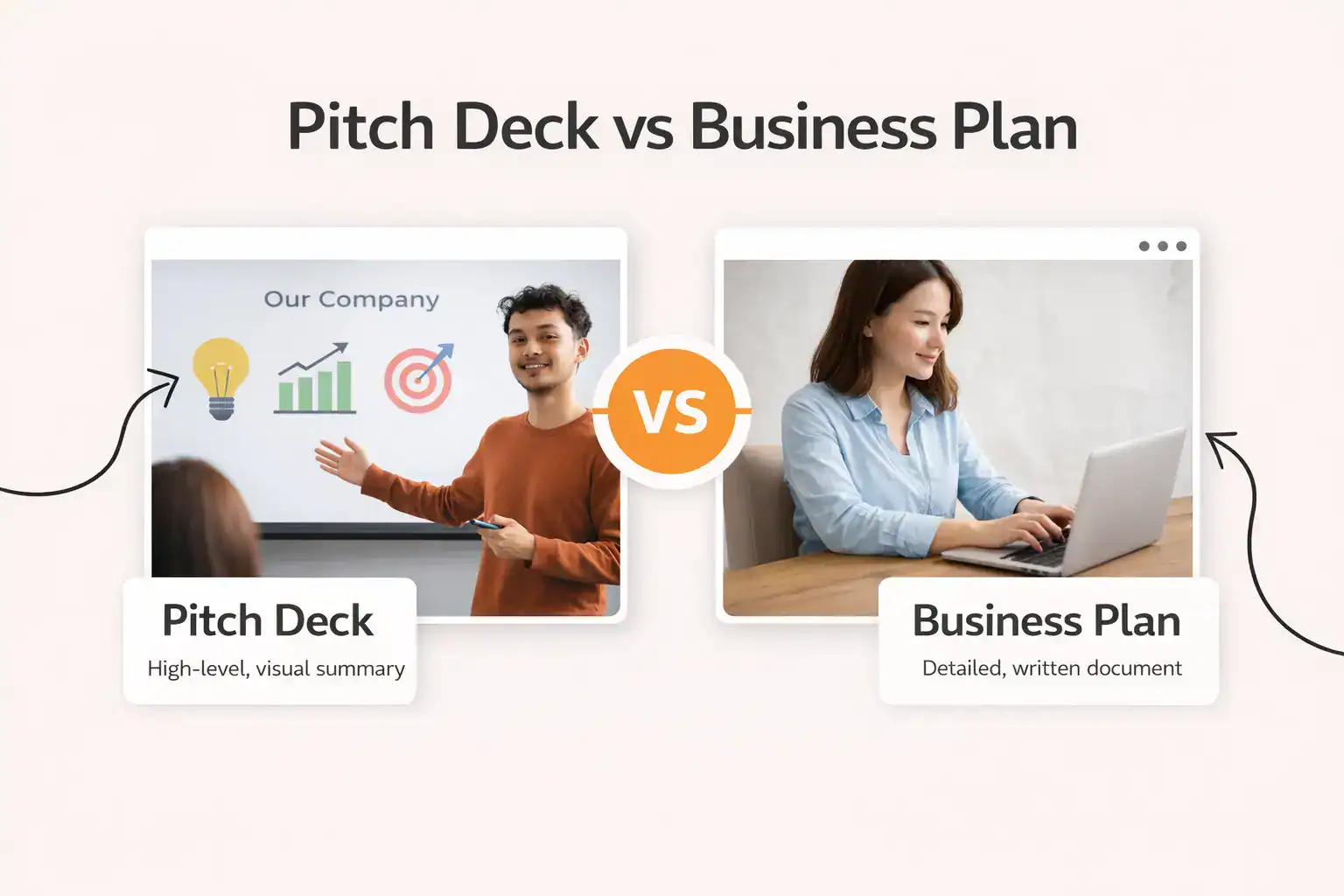
If you’re an entrepreneur, you’ll probably hear “pitch deck” and “business plan” even before starting your business. Business mentors talk about them, incubators require them, and investors ask for them, sometimes all in the same conversation. Don’t mistake the two terms as interchangeable, however.
A pitch deck and a business plan have fundamentally different roles. They share different levels of detail, and are used in different situations. Here’s what they are, and how to craft each one. You may need one, the other, or likely both.
What is a pitch deck?
A pitch deck is a short presentation that’s intended to inform and excite people about your business. They give a high-level overview, and are usually visual presentations (e.g. PowerPoint, Keynote, Google Slides, etc.).
You might include a few statistics or specifics in your pitch deck, but only so far as they contribute to a better overarching understanding of your business and the opportunity. The goal is to engage and excite, which will hopefully lead to more in-depth future discussions.
Movie Analogy: If your business opportunity were a movie, the pitch deck would be its trailer. The deck communicates what your business is about, is highly visual, includes only a few highlights, and leaves the audience wanting to know more.
You’ll most often use a pitch deck when presenting to people whose help you want. These could be potential investors during fundraising series, or they could be fellow partners when discussing where to take the business. You’d also want a pitch deck if proposing to a government agency, or in similar situations.
When crafting a pitch deck for these audiences, keep everything high-level. The deck is for conversations early on with these people, before they need to know all of the documentation and particular details. In other words: Summarize.
Example questions to answer in your pitch deck:
- What’s the target market?
- What problem needs solving?
- How are you solving that problem?
- What’s your unique value-add?
- How will you generate revenue and profits?
- What are you asking for?
- Why are you uniquely suited for this?
While you don’t want to go into too many details, do be specific when answering some of these questions. Most importantly, clearly state what you’re asking for.
What is a business plan?
A business plan is a fairly comprehensive written document that covers the various aspects of starting a business: customers, operations, pricing and costs, projected revenues and profits, stakeholders, risks, and how to execute. You can add other sections as appropriate.
The purpose of your business plan isn’t to persuade, but rather to prepare. It forces you to show that your idea can indeed be transformed into a viable business, and how you’ll get there.
Movie Analogy: If the pitch deck is your business’s trailer, its business plan is the script. This is the details of your target market and suppliers (setting), customers and stakeholders (characters), projections and execution (plot).
You’ll use a business plan to explain the business to partners, investors and other stakeholders. You may also need it when talking with third parties that have a long-term interest in your business succeeding, such as landlords, grant underwriters, and government agencies (if applicable).
Example questions to answer in your business plan:
- How will you reach target customers?
- What’s the competitive landscape?
- How will your business produce and provide its goods/services?
- What’s your marketing plan and budget?
- What are labor costs, costs of goods, overhead, etc.?
- Will you need to hire employees?
- What are your sales, revenue and profit projections?
- What are the rewards and responsibilities of each stakeholder?
- What risks are there, and how do you adjust?
- What is your projected timeline, and milestones to hit?
This is where you should be detailed when answering these questions. You could find there are additional sections to include in your business plan, too.
Pitch deck vs business plan: key differences
Here’s a pitch deck vs business plan breakdown of the differences. Keep these in mind when creating each.
Purpose
- Pitch deck: Introduce people to your business. Spark further conversations, secure meetings, and gain buy-in.
- Business plan: Plan and explain the details of your business. Think through the many aspects of the business yourself. Show stakeholders that your idea is viable, and you’re ready to execute on that idea.
A pitch deck is both intellectual and emotional. The response is hopefully, “Interesting. Tell me more.”
A business plan is almost solely intellectual, although there is some space for a “do good” aspect if you’re a B-corporation, investing in social causes, or a nonprofit. It hopefully leads to, “This is well thought through and doable. I’m in.”
Level of detail
- Pitch deck: High-level summary. Highlights the essentials, using selective details only when they support credibility.
- Business plan: Comprehensively detailed. Works through assumptions, including specific presuppositions and conclusions that can be evaluated.
This is one of the most important pitch deck vs business plan key differences. Decks intentionally leave out many operational specifics, while plans must include virtually all of them. You should include citations (e.g. market research), appendices (e.g. contingencies), and tables and charts (e.g. full financial projections).
Format
- Pitch deck: Slides and other visuals, possibly pictures, charts and even a short video. Text should be brief.
- Business plan: Written document, with clear sections, paragraphs and supporting details. The only visuals should be slides and charts.
You’ll almost always be presenting a pitch deck during in-person or virtual meetings. A business plan should stand on its own. You’ll present it sometimes, but also send it to people without additional explanation.
Audience
- Pitch deck: Partners, investors, potential stakeholders, etc. Anyone who needs a clear, quick overview.
- Business plan: Partners, investors, loan officers, grant underwriters, etc. Anyone with a financial interest in your business, or who needs to know its operations.
A pitch deck is for people who might be interested in your business. A business plan is for those who are, or at least are seriously considering joining in some capacity.
When you might need a pitch deck
You may need a pitch deck, but not all entrepreneurs have to create one. Make one if you’re presenting to others who are potentially interested. For example, you’ll want a deck if you are:
- Formally introducing your business
- Presenting to partners
- Seeking outside investment
In some cases, you might even have a shortened pitch deck that takes only a few minutes to present. Think of this as your “elevator pitch” deck.
A pitch deck is unnecessary if you’re a local dry cleaner who’s self-funding. It’s a must if you’re a B-corp organic farm seeking ESG investors (environmental, social, governance).
When you might need a business plan
Every entrepreneur should write a thorough business plan. If you never show it to someone else, this will force you to think through the minutiae of your business.
Yes, the self-funded dry cleaner needs a plan. Maybe your child’s lemonade might even benefit from having one. It’d at least be a good exercise for them, and you.
You’ll want a business plan if:
- Applying for business loans or small business grants
- Seeking outside investment
- Planning with other stakeholders
- For your own planning
Do you need both a pitch deck and a business plan?
Sometimes business owners need both a pitch deck and a business plan, but not always. You’ll need a business plan regardless, and might also use a pitch deck. Using the two together can be a powerful combination of storytelling and documentation.
If you do need both, each should inform the other. A pitch deck can summarize the major points of a business plan. A business plan can flesh out what’s highlighted in a pitch deck.
Essentially, whether you need both depends on your business’s stage, your goals, and who’s involved. Don’t feel pressured to create a deck if you only need a plan.
Getting prepared before creating planning or pitch materials
To create a pitch deck and/or your business plan, you’ll need to understand the business well. Gather all relevant materials prior to opening PowerPoint or Word. You should know:
- Your Business: Make your general “big idea” as concrete and tangible as possible. Don’t just have a general concept. You need to know your business in order to tell others about it. What are you offering? Who are you offering it to? Why will people want this?
- Value-Add: Spend extra time defining your value-add, or what differentiates your business’s product/service from others. This could be as simple as location, or a highly technical algorithm. Whatever it is, the value-add must be part of both a deck and a plan.
- Structure: This includes the legal structure of your business (e.g. LLC, partnership, corporation, etc.), as well as personnel and operations. What will be done in-house? What will be outsourced? Where will any physical location(s) be?
Note: An LLC is perhaps the most common business structure. You can follow the steps to create one, or use an all-in-one LLC formation service. - Operational: How will your business actually deliver its good/service? Sourcing, producing and actually delivering are examples. There’s overlap with some aspects of structure here.
- Key Inputs: Key inputs are things like customer segments, costs, pricing, and delivery method. You can also include a timeline here.
- KPIs: Key performance indicators are how you’ll measure success. What sales, revenue or customer targets do you want to hit? These will overlap with inputs on your timeline.
- Numbers: Financials are the most important numbers. Nail down your costs, prices, projected revenues and projected profits, supporting these projections with citations. Customer acquisition costs, market size, and marketing costs are important, too.
Double-check that the numbers in your pitch deck are consistent with those in your business plan.
Assembling all of this information will take time. Making your deck and plan will be easy after doing the heavy lifting, though. You’ll also improve the quality of your materials.
Conclusion
Know the differences between a business plan vs pitch deck before you approach either. If you’re figuring out how to start your own business, understanding when you need a plan—and when a pitch deck helps—can make the process much more manageable. You’ll need the former, and might also need the latter. Consider your business’s complexity, goals and stakeholders, and then gather the necessary information. Doing this work and creating a plan and/or deck will set you up well for success. Here’s to your business efforts!
FAQ
A pitch deck is a short, high-level presentation meant to spark interest, while a business plan is a detailed document meant to prepare and show viability.
Anyone presenting to potential investors, partners, or stakeholders, especially when seeking outside investment, usually benefits from a pitch deck.
Yes, every entrepreneur benefits from writing one, even if it’s never shown to anyone else, since it forces clear thinking through the details of the business.
Not always, but many businesses use both together, with the deck summarizing key points that the plan explains in greater detail.
You should understand your business idea, value-add, legal structure, operations, key metrics, and financial projections before starting either document.