

So you want to start a business, or perhaps you’ve already started one.
You may not be sure you’ve done everything you can to protect yourself and your assets. Running a business is hard, so if you’re not all the way there yet, that’s okay. But whether or not to incorporate is an important question, so you’ll want to answer it sooner rather than later.
Incorporating is a legal process, though it’s less complicated than it sounds. It means registering your side hustle or full-time business with the state as a corporation, which makes the business a legal entity separate from you.
Separating yourself legally from your business doesn’t mean losing control of it. You keep a great deal of control over your business while gaining more protection for your personal life. As long as you’re at the right stage of your business, it’s a good idea.
This guide explains what incorporation is and how to do it. It covers the types of corporations, how they compare to an LLC, how taxes factor in, and the pros and cons of incorporating, followed by a step-by-step look at how to incorporate a business and answers to common questions.
The sections below walk through each structure, the tradeoffs, and the filing process in order.
Incorporation 101: what is a corporation?
It’s always helpful to start with the definitions, so here are a few of the most important terms and facets of incorporation.
For legal purposes, a corporation is a separate entity from the people who own and run it. That means the law treats it as though it has its own rights and responsibilities. It can borrow money, own assets and sign contracts in its own name.
On the other hand, being an entity has a few downsides as well. A corporation can also be sued and must pay its own taxes.
Incorporating also adds new structures to your business, such as shareholders, a board of directors and officers, and each brings different responsibilities. A couple of the main benefits are below.
Protection from liability
One of the main reasons to incorporate is protecting yourself from personal liability. Separating yourself from your business means that if something goes wrong, you personally are usually not the one who has to pay.
For instance, if you leak clients’ data unintentionally and they sue you, you have no protection as a sole proprietor, someone who runs their business as an arm of their personal life, both legally and tax-wise. You may have insurance (and you should), but once that insurance is exhausted, your personal bank account and assets are exposed to the remaining claim.
As a corporation, however, you have protection from liability. If the business gets sued, it gets sued, not you. That means when the corporation’s assets are exhausted, the business may fail, but your home, car and retirement savings are generally safe.
Sole proprietorships are simpler to run day to day, but that simplicity offers no protection the moment something goes wrong.
Liability protection isn’t the same thing as privacy. You can keep your personal address off public filings by using a registered agent, but most states still list a corporation’s directors or officers in public records. As most businesses operate publicly, though, this isn’t a huge issue.
Ability to issue stock, raise money, and go public
Avoiding legal liability isn’t the only reason to incorporate. There are plenty of benefits that have nothing to do with steering clear of the courtroom.
For instance, corporations can raise money by selling shares. While an enthusiastic friend or parent might invest in your sole proprietorship, most venture capital funds only invest in C corporations, often ones formed in Delaware, because shares make it easy to divide ownership and profits.
By the same token, incorporating allows you to issue stock to the owners of the company. A C corporation can also go public, which means letting people outside the company buy its stock on a public market.
Business structure versus business taxation
One final facet of incorporation is that a business’s legal structure and its tax treatment aren’t always the same thing.
The S corporation is the clearest example. An S corp isn’t a separate type of business entity. It’s a federal tax status that an eligible corporation or LLC chooses by filing Form 2553 with the IRS.
LLCs show the same split. An LLC (limited liability company) gives its owners liability protection, like a corporation, but it isn’t a corporation. By default, the IRS treats a single-member LLC as a disregarded entity, taxed on the owner’s personal return using Schedule C, and a multi-member LLC as a partnership. An LLC can also choose to be taxed as a C corp or an S corp. Your tax preparer is the best person to help you decide.
The point is that legal and tax structures are often different, and your situation and your state will determine how you approach both.
Which raises the next question: what types of corporations are there?
Types of corporations
Choosing the right structure starts with understanding what each option actually offers.
The main choices for a small business are the C corporation, which is the standard corporation, and the S corporation, which is a C corporation (or LLC) that has elected S corp tax status. Many owners also compare both with an LLC. Each has different requirements, different pros and cons, and different appeal depending on what kind of business you run and what your future goals are.
C corporation (C corp)
A C corporation is the default type of corporation. When you file articles of incorporation, your business is a C corp unless it elects S corp status.
One of the biggest items of note for a C corp is that it’s not a pass-through entity. The corporation pays federal income tax on its profits at the 21% corporate rate, and shareholders pay tax again on any dividends they receive.
This is known as double taxation, and it’s one of the main tradeoffs of choosing a C corp. You can learn more in the C corporation tax guide. This might make being a C corp seem unappealing, but there are major benefits that make up for it. A C corp can have any number of shareholders, issue different classes of stock, and take investment from venture capital funds and foreign investors.
S corporation (S corp)
An S corporation has the same limited liability as any corporation, because it’s a separate legal entity from its owners. The difference is taxes: an S corp is a pass-through entity, so profits and losses flow to the owners’ personal tax returns instead of being taxed at the corporate level.
To qualify, the business must meet the IRS S corporation requirements. It can have no more than 100 shareholders, who must generally be U.S. citizens or residents, and only one class of stock. Owners who work in the business must pay themselves a reasonable salary before taking other profits as distributions.
Corporations have perpetual existence, which means they live on even if ownership changes. An S corp can raise capital and issue stock, but the shareholder limits mean it can’t go public. See S corp vs. C corp for a side-by-side comparison, or estimate your potential savings with the S corp calculator.
How corporations compare to an LLC
Limited liability companies aren’t corporations, but they offer the same limited liability. Owners’ personal assets are generally off-limits when it comes to the company’s lawsuits, debts or other liabilities.
LLCs also benefit from flexible taxation. By default, the IRS treats them as pass-through entities, so the owners are taxed on their personal income tax returns using Schedule C (single-member LLCs) or a Schedule K-1 (multi-member LLCs).
It’s easy to register an LLC, and it has fewer formalities than a corporation: no board of directors, no required shareholder meetings and no bylaws. Investors who want shares, especially venture capital funds, usually prefer a corporation. See C corp vs. LLC for a closer comparison.
| Item | LLC | C corp | S corp (tax election) |
|---|---|---|---|
| Owners | Unlimited members | Unlimited shareholders | Up to 100 eligible shareholders |
| Federal tax | Pass-through by default | 21% corporate tax, then tax on dividends | Pass-through |
| Formalities | Few | Board, bylaws, meetings, minutes | Same as the entity it elects for |
| Raising capital | Members only | Any investors, multiple stock classes | One class of stock |
| Best for | Most small businesses | Startups seeking investors | Profitable owners paying themselves a salary |
Unincorporated business structures
There are 2 general unincorporated business structures. The first is the sole proprietorship, in which one person owns and runs the business without forming an entity.
The second is a general partnership, when 2 or more people run a business together without forming an entity. Partners share profits and are personally liable for the business’s debts.
Neither structure requires a state filing to exist, though both may need a DBA and local licenses. A financial or tax advisor can help you decide which type of entity is right for you, and the pros and cons below can help you compare.
Benefits and disadvantages of incorporating a business
As with anything else in life, incorporating your business comes with significant advantages as well as disadvantages. No single one should decide it for you. It’s more about what works for you, your customers, and your goods and services.
Benefits of incorporating your business
Some of the benefits of incorporating your business are listed below.
- The ability to raise capital by selling shares to investors
- Tax options, such as the 21% corporate rate or an S corp election, that a sole proprietorship doesn’t offer
- An additional layer of privacy that comes from appointing a registered agent, so your home address stays off the public record
- Limited liability to protect your personal assets
Downsides of incorporating your business
Incorporation has its downsides as well. Here are the main ones.
- More paperwork to get set up and to remain in compliance with the state and federal governments
- More formalities, such as bylaws, board meetings and minutes
- More costs, including state fees, annual reports and possibly franchise taxes
- Double taxation (in the case of C corps)
- Shared decision-making if you have other shareholders and directors
So, is incorporation right for you? That depends on when you’re ready to make the jump.
When to consider incorporating
Remember, small businesses can operate as sole proprietorships for a long time, so you don’t have to incorporate. However, there are certain situations when you really should. For instance, consider incorporating if any of these apply.
- You do work that could be considered risky, such as building houses, work where personal injury is a real possibility, or managing other people’s money
- You want access to more funding and investment opportunities
- Your tax professional has told you that a corporation or an S corp election could reduce your tax burden
- You’re going to sign legal contracts as part of your work and want that extra layer of liability protection
- You plan to hire employees, and as a business you’re responsible for their actions
- You’re bringing a partner on board, which adds another person to the equation without adding any protection for your personal assets
- You want to look professional in front of clients and customers
Some fields require you to be bonded and insured before you can get to work, even if you’re a sole proprietor. However, even insurance doesn’t protect you if your coverage can’t handle the entire amount of a claim, at which point your personal assets are on the line.
Corporation requirements
If you’ve decided to incorporate your business, here’s what’s actually required.
As with the other sections in this post, the rules of your state, the laws that govern your specific field and other factors all affect which steps apply to you. Check with a professional before making a big business decision.
In general, you will need most of the following to incorporate your business.
- Business name
- Business structure
- Articles of incorporation
- Registered agent
- Bylaws
- Board of directors
- Shareholders
- EIN (Employer Identification Number)
- Business license
- Bank account
- Shareholders’ agreement
- Insurance
Depending on your exact situation, you may be able to skip some of these. Likewise, there may be additional requirements depending on your state and the type of business entity you choose.
How to incorporate your business: a step-by-step guide
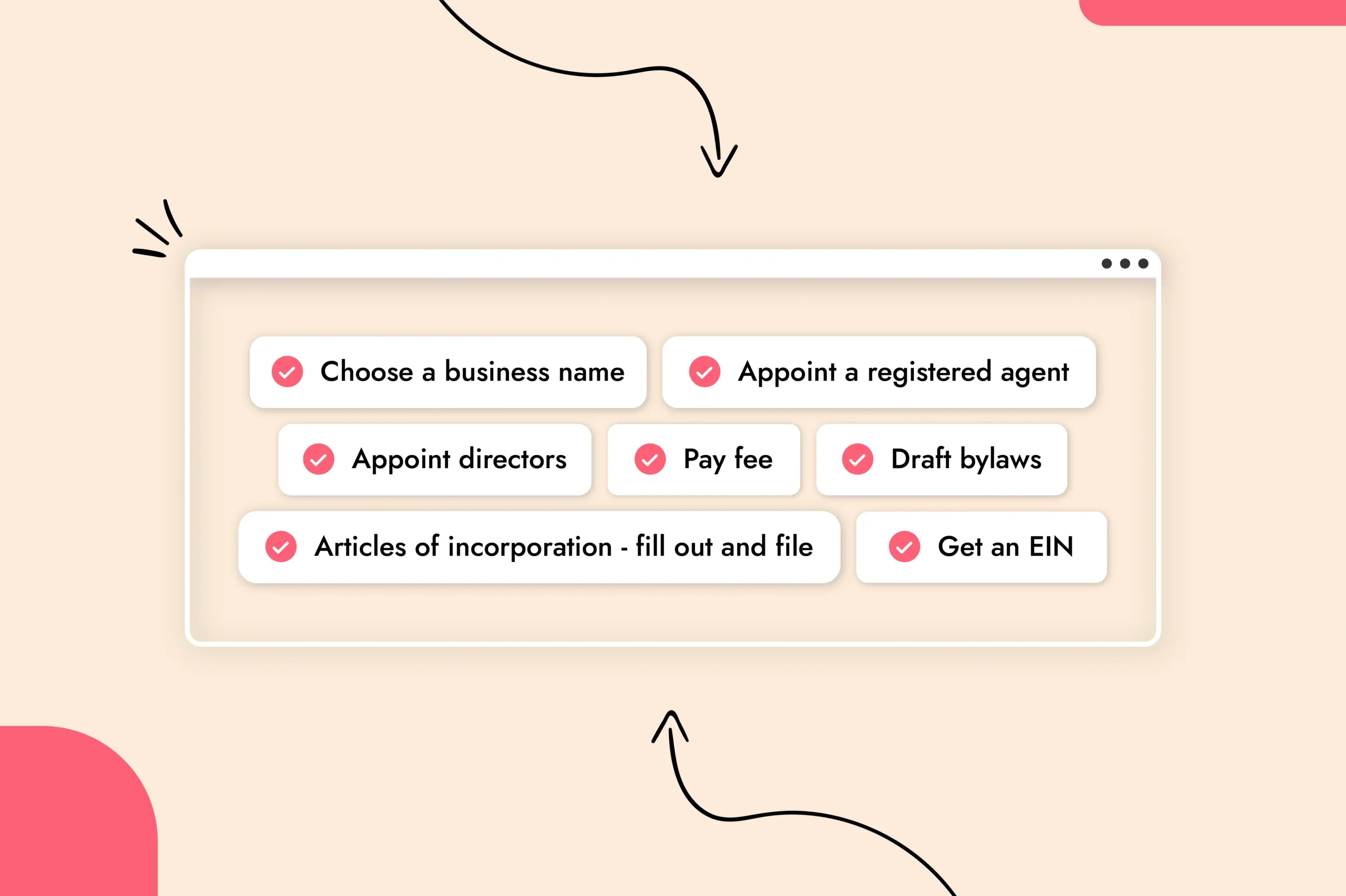
If you’ve decided you’re ready to take the plunge, here’s a step-by-step guide for what to do before and after incorporation.
Determine your business structure
As discussed above, your business’s structure has a great deal of influence on its protection, freedoms and taxes. Choose the one that best fits your needs, ideally with the help of a professional. Most small businesses incorporate in their home state. Delaware is popular with startups that plan to raise venture capital, but you’ll still need to register as a foreign corporation in the state where you operate.
Choose a business name
Your business will need a name, of course. Make sure it’s unique, memorable and easy to brand. You should also make sure that it can grow with your business, so it won’t be too limited in scope if you add new services or product lines. Most states also require a word like “Corporation,” “Incorporated” or “Inc.” in the name.
Lastly, run a business entity search to make sure the name is available in your state. Even when two names are different enough for the state, trademark laws and marketing common sense make a too-similar name a bad idea.
Appoint a registered agent
A registered agent is a person or business with a street address in your state who is available during regular business hours to accept legal papers and official notices on your behalf.
You can be your own registered agent, but many people choose a registered agent service for an extra layer of privacy. When someone else fills the role, it’s their address that goes on the public record, not yours. Whatever you decide, you will need to appoint a registered agent. Registered agent services typically cost $50 to $300 a year, and Tailor Brands’ service is $199 a year.
You must list your registered agent in your articles of incorporation. If you haven’t decided who it will be, you can list yourself. However, remember that even in the interim, your address will become public record.
Appoint directors
Every corporation needs at least one director, and both C corps and S corps have a board of directors. (An LLC doesn’t need one.) Some states require you to name your initial directors in your articles of incorporation, so decide before you file.
Issue stock
A corporation must authorize shares in its articles of incorporation, including the number and type of shares. After formation, it issues stock to its first shareholders, so decide who the shareholders will be and how many shares each will receive.
File articles of incorporation
With the above information, it’s time to file your articles of incorporation. Some states call this document a certificate of incorporation (Delaware) or a certificate of formation (Texas). It’s the document that creates your corporation under state law.
You file it with your state’s Secretary of State or business filing office, which publishes the forms, filing rules and fees.
Draft your bylaws
Bylaws are the rules for how your corporation is run. They set guidelines for how shareholders, directors and officers make decisions and what rights each one has.
Things to do after you register a corporation
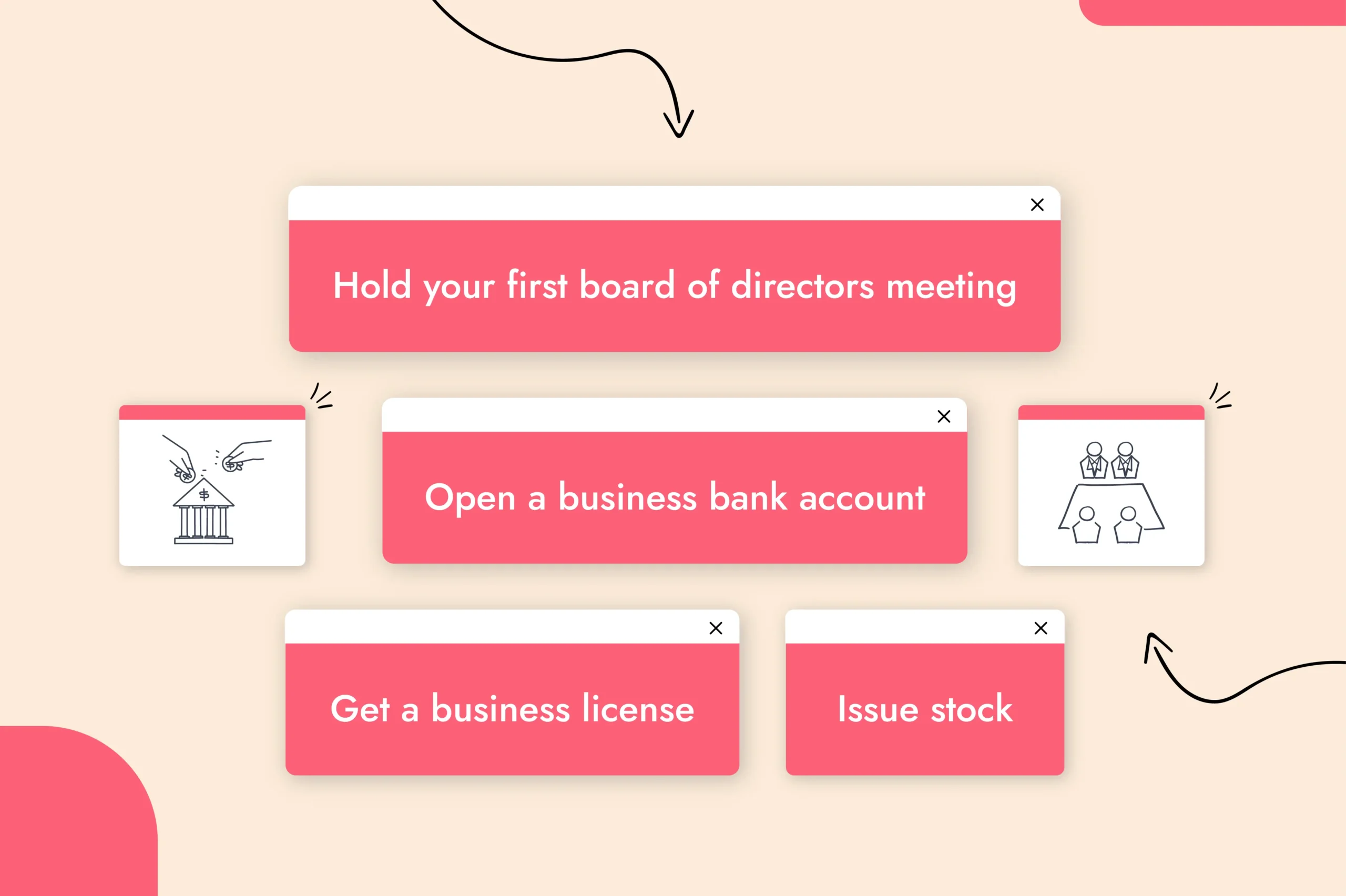
Once your business is registered, a few tasks remain before you’re fully operational.
Register a DBA if needed
If you want to do business under a name different from the legal name in your articles of incorporation, you will need to register a DBA, or “doing business as” name, with your state or county.
Get an EIN
You don’t need an EIN (Employer Identification Number) to file your articles of incorporation, but you will need one to hire employees, file your corporate tax returns and open a business bank account.
You can get an EIN from the IRS online for free.
Choose tax election
Your corporation is taxed as a C corp unless it elects S corp status. To become an S corp, file Form 2553 with the IRS no later than 2 months and 15 days after the start of the tax year the election is to take effect. Talk to a tax professional first.
Get licenses and permits
The required licenses and permits vary widely, depending on your industry, your location, and your state and local laws. Make sure you get the correct ones to remain in compliance.
Open a business bank account
A separate business bank account keeps the corporation’s money apart from yours, which helps protect your limited liability. You’ll also need one to get loans and receive investment money.
Hold an initial board of directors meeting
After incorporating, the directors hold an organizational meeting to adopt the bylaws, appoint officers, authorize the issue of stock and handle other first steps. In a small business, the shareholders and directors may just be you alone or you and a few others, but the meeting and its minutes still matter for keeping your corporation’s records in order.
The laws of your state set the minimum number of directors, often just one. If you can’t find the information online, ask an expert.
Get insurance
Yes, corporations need insurance to protect their assets from financial risks. Insurance can help protect a corporation from lawsuits, natural disasters and other unforeseen events. Without insurance, financial problems can quickly cripple the business.
The exact type of insurance you need will vary according to your industry. It will also depend on whether you have employees and what services you provide.
Common types of insurance include general liability, commercial auto, workers’ compensation, professional liability and liquor liability, and the list goes on.
In a nutshell, you will probably need insurance if your business operates dangerous equipment, has expensive assets, has employees, handles sensitive information (e.g. financial or medical), or runs one-time events (think weddings or helicopter trips). An insurance agent will help you think through the details.
Draft a shareholders’ agreement
Shareholders’ agreements tell you what to do in case of disagreement. They’re recommended for any corporation with more than one shareholder. A shareholders’ agreement helps in three main ways.
- Balance power and create a pathway to making important decisions
- Protect minority shareholders by setting rules for selling stock
- Settle disagreements between family and friends who go into business together
Ideally, you should create your shareholders’ agreement early in the process.
Keep up with ongoing compliance
After you incorporate, most states require an annual or biennial report, and some charge a franchise tax. Keep holding board and shareholder meetings, record minutes, and keep the corporation’s finances separate from your own to protect your good standing and your liability protection.
How much does it cost to incorporate a business?

The costs of incorporating a business vary widely by state.
Every state charges a fee to file articles of incorporation, from about $50 to $300 or more. Some states add an initial report, newspaper publication or a fee based on the number of shares you authorize.
If you don’t prepare your articles of incorporation yourself, you will need to pay for help, and an attorney will usually cost more than a filing service. Documents such as bylaws and shareholders’ agreements may also add legal fees.
Other costs can include annual reports, franchise taxes, registered agent services (if you choose to hire a service), and business licenses.
Conclusion
Incorporating involves real paperwork, and getting it wrong can mean delays or having to refile. Tailor Brands can handle the filing for an LLC, S corp, or C corp, so you can spend that time running your business instead. Either way, the sooner you incorporate, the sooner your personal assets stop being exposed to the business’s liability.
FAQ
A corporation is a legal entity that is separate from its owners. It has its own rights and responsibilities, can own property and sign contracts, and protects shareholders from most business debts.
An LLC is a limited liability company, not a corporation. Both protect owners from business debts, but a corporation has shareholders, directors and bylaws, while an LLC has members and fewer formalities.
It depends on your goals. An LLC is simpler and suits most small businesses, while a corporation is usually better if you plan to raise venture capital or issue different classes of stock.
A C corp pays corporate income tax, and shareholders pay tax again on dividends. An S corp passes profits through to its owners, but it’s limited to 100 eligible shareholders and one class of stock.
State fees to file articles of incorporation range from about $50 to $300 or more. You may also pay for help preparing documents, a registered agent, and annual reports or franchise taxes.
A corporation’s bylaws lay out the rights and responsibilities of everyone at the company, from directors to officers to shareholders, and set the rules for meetings and decisions.
It’s not legally required, but it’s a good idea for any corporation with more than one shareholder. It gives you an agreed set of rules for resolving disputes and selling shares.
Yes. An eligible LLC can elect S corp taxation by filing Form 2553 with the IRS. It stays an LLC under state law but is taxed like an S corporation.
Usually only if you plan to raise venture capital. Most small businesses incorporate in their home state, because a Delaware corporation must also register and pay fees in the state where it operates.