
The State of the American Founder 2026
How AI Displacement is Fueling the Founder Boom
Two numbers, both from March 2026, sit very close together and explain almost everything happening in the American economy right now.
In a single month, U.S. employers announced 60,620 job cuts — up 25% from February — with artificial intelligence cited as the leading reason, responsible for 15,341 of those losses. Goldman Sachs has put the running estimate at roughly 16,000 U.S. jobs disappearing to AI every month.
In that same month, 580,612 Americans filed paperwork to start a new business — the third-highest monthly total ever recorded. The country is now home to roughly 30 million solo entrepreneurs, and more than 50 million Americans currently earn at least part of their income outside a traditional job, a 15% jump from a year ago.
AI isn’t just taking jobs at the top of the economy. It’s pushing a record number of Americans to build their own at the bottom. This report is about that second movement — what those people are actually building, in their own words.
The question
To find out, we asked over 1,000 early-stage founders a deceptively simple question:
“If you had to pitch your business idea in one sentence, what would it be?”
Across 1000 distinct, analyzable responses, a clear pattern emerged. The answer to job displacement, for most Americans, isn’t to retrain into prompt engineering or to wait on Washington. It’s quieter, older, and — based on this dataset — overwhelmingly human.
Only 5% of pitches contained any classic startup language — no “platform,” no “SaaS,” no “AI,” no “scale,” no “disrupt.” The other 95% were building something else: services, brands, communities, and lives they own outright. The most common word in the entire dataset wasn’t app or platform. It was help.
Six findings from 1,000 founders
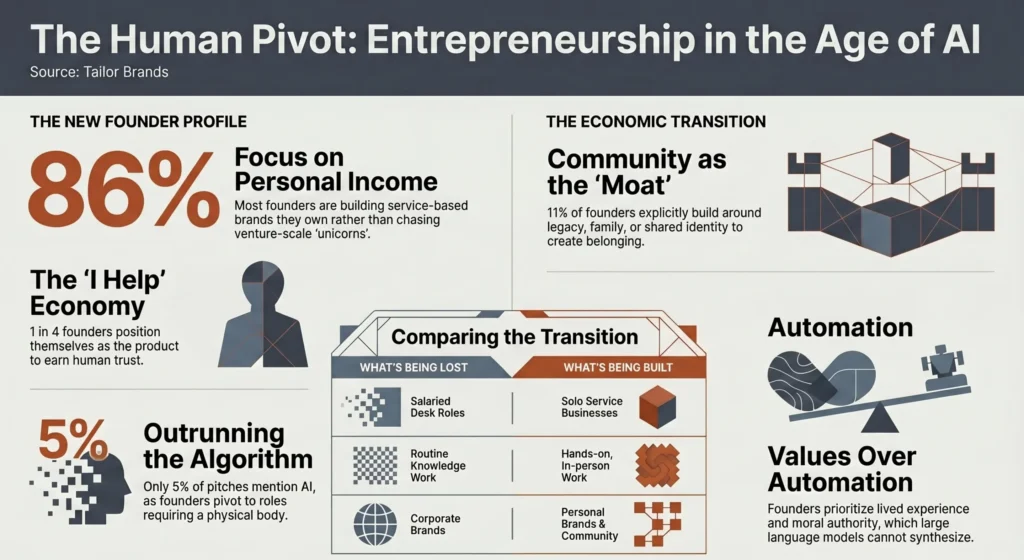
1. This isn’t startup-style entrepreneurship. It’s defensive.
Founders aren’t chasing scale. They’re chasing something the layoff letter can’t take away — income they own, on terms they set.
86% described a personal-income business — a service the founder delivers, a brand built around themselves, or a small product line.
5% used venture-style language. The unicorn cohort is a rounding error in the actual founder population.
The pitches read like the front page of a small American town: a mobile mechanic, a junk-removal company, a candle line, a tax preparer, a hot-dog cart, a dog-grooming studio. None of these are speculative bets. They are deliberate, person-shaped responses to an economy where “employee” is starting to feel like a precarious role.
“Start up hot dog cart coming to the Treasure Valley of Idaho!”
“The mechanic who comes to you!”
“Retire my family and friends through real estate!”
2. The “I help…” economy is what humans build when they can’t be replaced by an API.
Roughly 1 in 4 pitches opened with “I help,” “I empower,” “I provide,” or “I offer.” The founder isn’t selling a product. They ARE the product — and that’s exactly the point.
AI is dramatically better than humans at generating words. It is dramatically worse than humans at sitting across a table from a stranger and earning their trust. Today’s founders are positioning themselves directly into the gap: outcomes for specific people, delivered by a person whose name is on the door.
“I help small business owners save time and money by giving them clear, accurate financial information they can use to make smarter business decisions.”
“I help families in the DDD community utilize their budgets for essential needs in the world.”
“I empower individuals to take control of their health and wellbeing through personalized coaching that helps them build sustainable habits, improve energy, and achieve lasting balance.”
Where a 2010s pitch deck started with a market and ended with a TAM, a 2026 pitch starts with a person and ends with an outcome. AI can write the pitch. It cannot, yet, be the founder.
3. Business is becoming personal — because the personal is what doesn’t automate.
9% of pitches were rooted in faith, healing, recovery, identity, or community. A much larger share carried the unmistakable fingerprint of personal experience.
Grief-driven streetwear. A faith-based stationery line. A doula serving her own community. A trauma-informed caregiving agency for veterans. These businesses are deliberately built around what large language models can’t synthesize: lived experience, moral authority, and earned credibility.
“Nothing Positive is a brand born from pain, turning grief, heartbreak, and life’s darkest moments into wearable reminders that survival is strength and healing is real.”
“A faith-based lifestyle brand that helps people experience God’s presence daily through transformative content, creative services, and spiritual resources.”
“I help people who are navigating serious medical illness and their loved one’s to learn to process their emotions.”
Entrepreneurship is no longer just economic. It’s emotional and identity-driven. People aren’t just building businesses — they’re building meaning.
4. AI is in the room — but founders aren’t riding it. They’re outrunning it.
Only 5% of pitches mentioned AI, automation, or platform language. The headlines have AI everywhere. Founders, mostly, do not.
There is, in this dataset, a clear bifurcation. A small minority is building AI-native companies — the textbook startup pitches. They stood out precisely because they were so rare:
“My business idea is to create a dynamic, AI-driven personal assistant platform, which intuitively streamlines digital tasks and personal organization by integrating seamlessly across all user devices and applications.”
They were outnumbered, by a factor of about 19 to 1, by cleaning services, mobile notaries, beekeepers, locksmiths, candle makers, real-estate investors, and home-care agencies. The implicit thesis behind the 95% is unspoken but unmistakable: if AI is going to eat the desk job, build something AI can’t do.
5. “Everyday essential” is the new safety net.
A huge slice of the dataset was made up of businesses solving simple, real-world problems — closer to your house, faster to your door, kinder to your time.
Convenience, reliability, and trust are quietly becoming the new competitive advantages. The pitches don’t promise to disrupt an industry. They promise to show up. Crucially, almost all of them require a body in a room — the single hardest thing for a software model to replicate.
“Healthcare on the move, bringing Phlebotomy mobile services to your doorstep.”
“My Locksmith business is your one stop shop for all your security needs. Available 24/7 and reaching your location within 15 minutes, we are dedicated to ensuring your safety every step of the way!”
“A trusted and professional tax preparer navigating today’s regulatory environment on your behalf so you can stress less and enjoy your family, friends and free time.”
6. Community is the moat.
11% of pitches explicitly invoked legacy, family, or generational impact. Many more framed their business as a way to gather a tribe.
Founders aren’t just selling to customers. They’re building belonging. A Disabled-Veteran-Owned caregiving company. A Black-woman-owned non-alcoholic lounge. A faith-based childcare cooperative. A real-estate firm whose stated mission is to retire its own friends and family. In a labor market where institutions feel less and less reliable, these businesses are quietly rebuilding the institution-shaped hole.
“I started my business as a veteran-led company to build and manage real estate and investment businesses that grow wealth over time.”
“My business is a Disabled Veteran Owned Caregiving Company focused on providing dignity and compassion to all clients in need of all aspects of in home care.”
“I help everyday women and go-getters turn their ideas into digital income using my freedom formula suite — a done-for-you system that runs 24/7, builds wealth while you sleep, and finally gives you the power to stop surviving and start scaling.”
What this means
Read together, the AI displacement data and the founder data describe the same story from two sides. Jobs are being squeezed at the top of the funnel. New businesses are being formed at the bottom. The country isn’t merely losing jobs to AI — it is, very quietly, replacing them with itself.
The shift, in plain terms:
| WHAT’S BEING LOST • Salaried desk roles • Routine knowledge work • One employer, one paycheck • Hours traded for benefits • Loyalty to a corporate brand | WHAT’S BEING BUILT • Solo service businesses • Hands-on, in-person work • Many clients, one personal brand • Skills traded directly for income • Loyalty to a community |
This is not a complete answer to AI displacement. The math is brutal: an LLC formed in March doesn’t fully replace the income of a senior role lost in February. But it is the answer most Americans are actually choosing, in real time, without waiting for permission. That deserves to be reported as accurately as the layoff numbers are.
Our perspective
At Tailor Brands, we are watching a generation re-architect its relationship with work in real time. People aren’t walking into our product to “raise a seed round.” They’re walking in because the org chart they used to live on isn’t safe anymore. They are looking for:
- An income stream that doesn’t depend on a manager’s mood or a model’s next release.
- A skill, turned into a brand, turned into a business they own outright.
- An LLC, a logo, and a website by the weekend, not a five-year plan.
- A way to start serving real customers on Monday.
The story we keep telling about AI and the labor market is incomplete without this second number. For every job AI is cited as eliminating, there are roughly 36 Americans starting a business this month. Some will succeed; many won’t. But the impulse to build something that can’t be laid off is one of the most important economic signals of the decade.
Our job is to help that impulse turn into a real business. Clearer than it started. Stronger than it expected. Theirs.
Closing
A single sentence seems small. But across 1,000 of them, a picture emerges.
AI may be writing the next decade’s headlines. But Americans, very quietly, are writing their own. One sentence at a time.
METHODOLOGY
Tailor Brands collected approximately 1,000 one-sentence business pitches submitted by entrepreneurs in its online community. The analysis covered 771 distinct pitches. Each pitch was classified using rule-based keyword heuristics across motivation (income & independence vs. mission & community vs. startup-track), business model (service, product, tech), and explicit demographic markers (faith, veteran/military, family/legacy). Tagging was conservative: any flag required an explicit keyword match. False negatives were preferred over false positives so that headline figures undersell rather than oversell the underlying signal. All quotes are reproduced verbatim from the source data, with surnames abbreviated to a single initial.
EXTERNAL DATA SOURCES
AI displacement and business-formation context drawn from publicly available reports as of April 2026:
- Challenger, Gray & Christmas, March 2026 Job Cuts Report (60,620 announced cuts; AI cited as leading reason for 15,341 cuts).
- Goldman Sachs labor-market analysis, April 2026 (estimated 16,000 U.S. jobs displaced by AI per month; Gen Z disproportionately affected).
- U.S. Census Bureau, Business Formation Statistics, March 2026 (580,612 new business applications; third-highest monthly total on record).
- Registered Agents Inc., 2026 Business Formation Report (5.9M new businesses formed in 2025, +8% YoY).
- Inc.com, Solopreneurship Is Set to Hit a Record High in 2026 (~30M U.S. solo business owners).