
Every successful business solves a problem.
The better you understand your customers’ frustrations, challenges, and unmet needs, the easier it becomes to create products, services, and marketing that resonate with them.
These problems are known as customer pain points.
For entrepreneurs, identifying customer pain points is one of the most important parts of starting a business and growing operations. Before refining your pricing, branding, or marketing strategy, you need to understand what your customers are trying to accomplish and what is preventing them from getting there.
73% of consumers say customer experience plays an important role in their purchasing decisions, which means businesses that fail to understand and address real customer pain points risk losing customers before they even convert.
Businesses that understand customer pain points can create stronger value propositions, improve customer experiences, and build products and services that people genuinely want to buy.
This guide explains what customer pain points are, the different types of customer pain points, how to identify them, and how to use those insights to improve your business.
What are customer pain points?
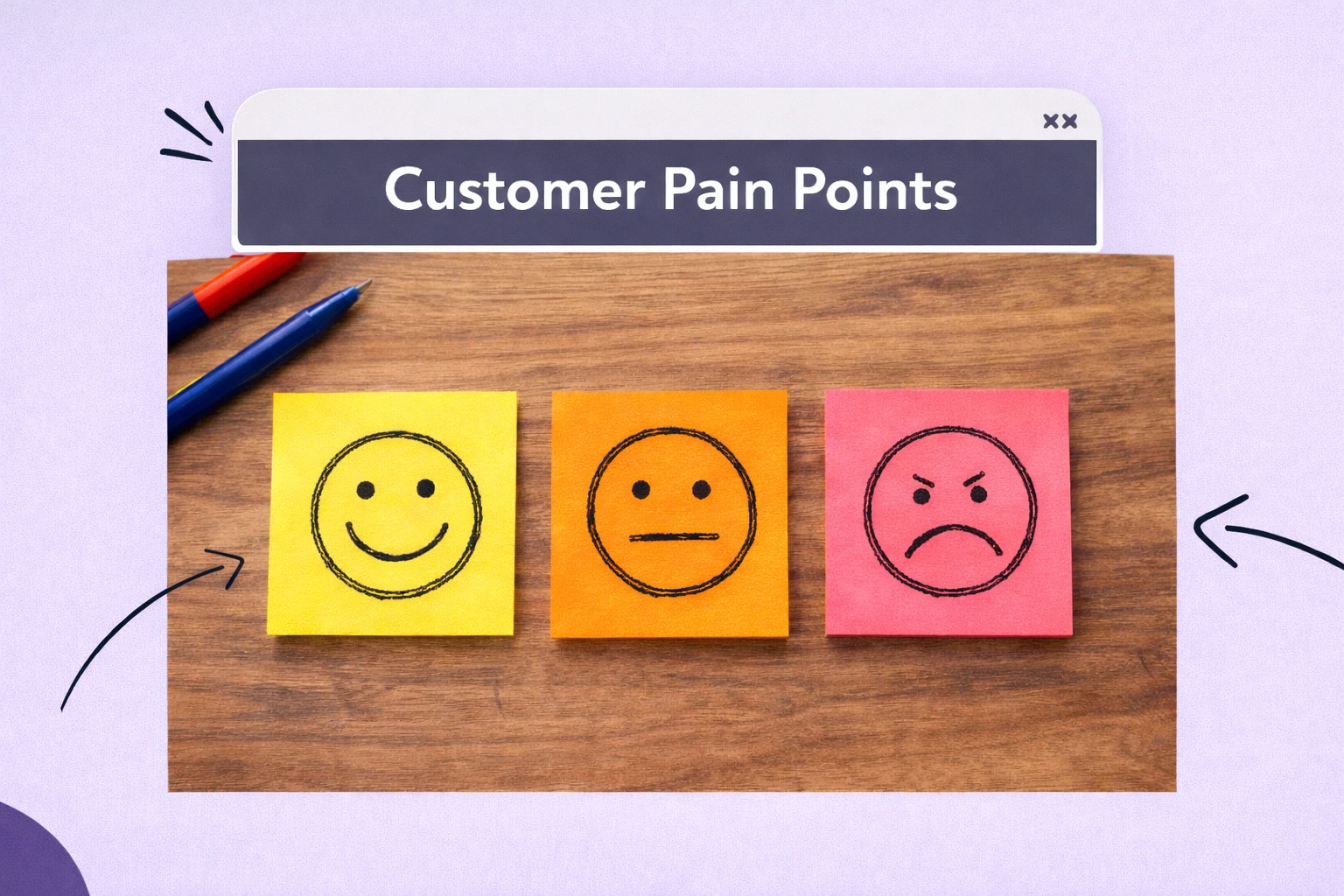
Customer pain points are specific problems, frustrations, obstacles, or unmet needs that customers experience while trying to achieve a goal.
These challenges can be practical, financial, emotional, or operational.
For example:
- A customer may be frustrated by expensive software subscriptions.
- A homeowner may struggle to find a reliable local contractor.
- A business owner may waste hours on repetitive administrative tasks.
- An online shopper may abandon a purchase because shipping costs are unclear.
Pain points create demand because people are actively looking for solutions.
The businesses that identify and solve those problems effectively often gain a competitive advantage.
Customer pain point versus symptom
One of the biggest mistakes businesses make is addressing symptoms rather than the underlying problem.
A symptom is the visible result of a deeper issue.
A pain point is the root cause.
For example:
- Symptom: Customers abandon their shopping carts.
- Pain point: Shipping costs aren’t disclosed until checkout.
Or:
- Symptom: Employees spend too much time entering data.
- Pain point: Existing workflows require repetitive manual tasks.
Understanding the difference helps businesses create solutions that solve the actual problem rather than temporarily masking it.
4 types of customer pain points
Most customer frustrations fall into one of four major categories.
1. Financial pain points
Financial pain points occur when customers feel they are spending too much money or not receiving enough value.
Common examples include:
- Products that are too expensive
- Hidden fees
- Subscription fatigue
- High maintenance costs
- Unclear pricing structures
Customers experiencing financial pain points are often searching for more affordable, transparent, or cost-effective alternatives.
2. Productivity pain points
Productivity pain points arise when customers waste time, effort, or resources.
Examples include:
- Repetitive manual work
- Time-consuming tasks
- Complex workflows
- Inefficient tools
- Too many steps in a process
Businesses that help customers save time often create significant value.
3. Process pain points
Process pain points occur when customers encounter confusing, frustrating, or inefficient experiences.
Examples include:
- Complicated onboarding
- Difficult account setup
- Unclear instructions
- Lengthy checkout processes
- Excessive paperwork
Simplifying processes can dramatically improve customer satisfaction and conversion rates.
4. Support pain points
Support pain points emerge when customers struggle to get help or answers when they need them.
Common examples include:
- Slow response times
- Lack of customer service
- Limited communication channels
- Poor documentation
- Difficulty reaching a real person
Businesses that provide fast, reliable support often earn stronger customer loyalty.
Customer pain point examples
Customer pain points vary across industries, but common patterns tend to emerge.
Ecommerce pain points
Online shoppers frequently struggle with:
- Unexpected shipping costs
- Long delivery times
- Complicated return policies
- Lack of product information
- Poor customer service
Businesses that simplify purchasing and improve transparency often see stronger conversion rates.
SaaS and software pain points
Software users commonly experience:
- Complicated onboarding
- Steep learning curves
- Too many unnecessary features
- Lack of training resources
- Limited support
Clear documentation, intuitive design, and strong onboarding can help reduce friction.
Local business pain points
Customers looking for local services often face:
- Difficulty comparing providers
- Unclear pricing
- Scheduling challenges
- Slow response times
- Lack of trust or credibility
Providing transparent information and quick communication can help address these concerns.
Professional service pain points
Clients seeking legal, accounting, consulting, or marketing services often struggle with:
- Understanding complex information
- Uncertainty about costs
- Slow communication
- Difficulty measuring results
- Limited visibility into progress
Simplifying communication and setting clear expectations can improve the customer experience.
How to identify customer pain points
The best businesses don’t guess what customers want. They gather information directly from customers and use that feedback to make informed decisions.
Ask customers the right questions
Customer conversations often reveal insights that analytics cannot.
Consider asking questions such as:
- What’s your biggest challenge related to this problem?
- What frustrates you most about existing solutions?
- What have you tried before?
- What would make this process easier?
- What almost stopped you from making a purchase?
The goal is to understand both the problem and the customer’s emotional response to it.
Pay attention to objections
Customer objections are often hidden pain points.
For example:
- “It’s too expensive” may indicate a financial pain point.
- “I need more time” may indicate uncertainty or lack of trust.
- “I’m not sure it will work” may reveal concerns about effectiveness.
Rather than dismissing objections, use them as opportunities to learn.
Read customer reviews
Reviews often contain honest feedback about what customers value and what frustrates them.
Look for recurring themes in:
- Your own reviews
- Competitor reviews
- Industry forums
- Social media discussions
Patterns often reveal opportunities for improvement.
Watch where people get stuck
Customer behavior frequently reveals pain points.
Pay attention to:
- Checkout abandonment
- Frequent support requests
- Drop-off points in onboarding
- Repeated questions
- Areas where customers hesitate
Friction often signals an underlying issue worth investigating.
Use market research
Market research helps businesses move beyond assumptions.
Customer interviews, surveys, competitor analysis, and behavioral data can help identify patterns and validate ideas before making major business decisions.
The more evidence you gather, the easier it becomes to prioritize the most important pain points.
Questions to ask customers to uncover pain points
If you’re conducting customer interviews or surveys, these questions can help uncover valuable insights.
- What is your biggest challenge related to this problem?
- What takes more time than it should?
- What frustrates you about your current solution?
- What would make your experience easier?
- What caused you to start looking for a solution?
- What nearly stopped you from making a purchase?
- What do you wish existing providers did better?
Simple questions often generate the most useful answers.
How to use customer pain points in your marketing
Understanding pain points is only valuable if you use those insights effectively.
Improve your value proposition
Your value proposition should explain exactly how your business solves a customer’s problem.
The clearer the connection between the pain point and the solution, the stronger the message becomes.
Strengthen website messaging
Many businesses focus heavily on product features.
Customers care more about outcomes.
Instead of leading with features, explain how your product or service eliminates a specific frustration.
Create better content
Pain points often provide ideas for:
- Blog posts
- FAQs
- Guides
- Videos
- Social media content
Educational content that addresses customer challenges can build trust before a purchase occurs.
Improve customer experience
Pain points don’t disappear after a sale.
Continuously looking for friction points throughout the customer journey can improve satisfaction, retention, and loyalty.
Customer pain point template
Use this simple framework when researching customers.
| Question | Answer |
|---|---|
| Who is the customer? | |
| What are they trying to accomplish? | |
| What frustrates them? | |
| What solutions have they already tried? | |
| Why haven’t those solutions worked? | |
| What pain point matters most? | |
| How does your business solve the problem? |
Completing this exercise can help clarify your positioning and improve your marketing messages.
Getting prepared before doing customer research
Customer research is most effective when you approach it with a clear plan.
Before conducting interviews, surveys, or market research, it helps to:
- Define your target audience
- Organize your research goals
- Document findings consistently
- Track customer feedback
- Keep business information organized
Strong organization makes it easier to identify patterns and turn insights into action.
Many entrepreneurs use platforms like Tailor Brands to help manage business formation, branding, compliance, and organizational tasks while focusing on understanding customers and growing their business.
Conclusion
Customer pain points explain why people buy.
The businesses that consistently identify and solve meaningful customer problems often outperform competitors with better products, larger budgets, or stronger brand recognition.
The process starts with listening.
Pay attention to customer questions, objections, frustrations, and feedback. Look for patterns, test assumptions, and focus on solving the problems that matter most.
The better you understand your customers’ pain points, the better positioned you’ll be to create products, services, and experiences that earn their trust—and their business.
FAQ
They’re specific problems, frustrations, or unmet needs customers experience while trying to achieve a goal, which can be financial, emotional, or operational.
A symptom is the visible result of a problem, like cart abandonment, while the pain point is the underlying cause, like undisclosed shipping costs.
The four types are financial, productivity, process, and support pain points, each reflecting a different kind of customer frustration.
Businesses can ask direct customer questions, pay attention to objections, read reviews, and observe where customers get stuck or hesitate.
Pain points can strengthen value propositions, shape website messaging, and inspire content that addresses real customer frustrations.