
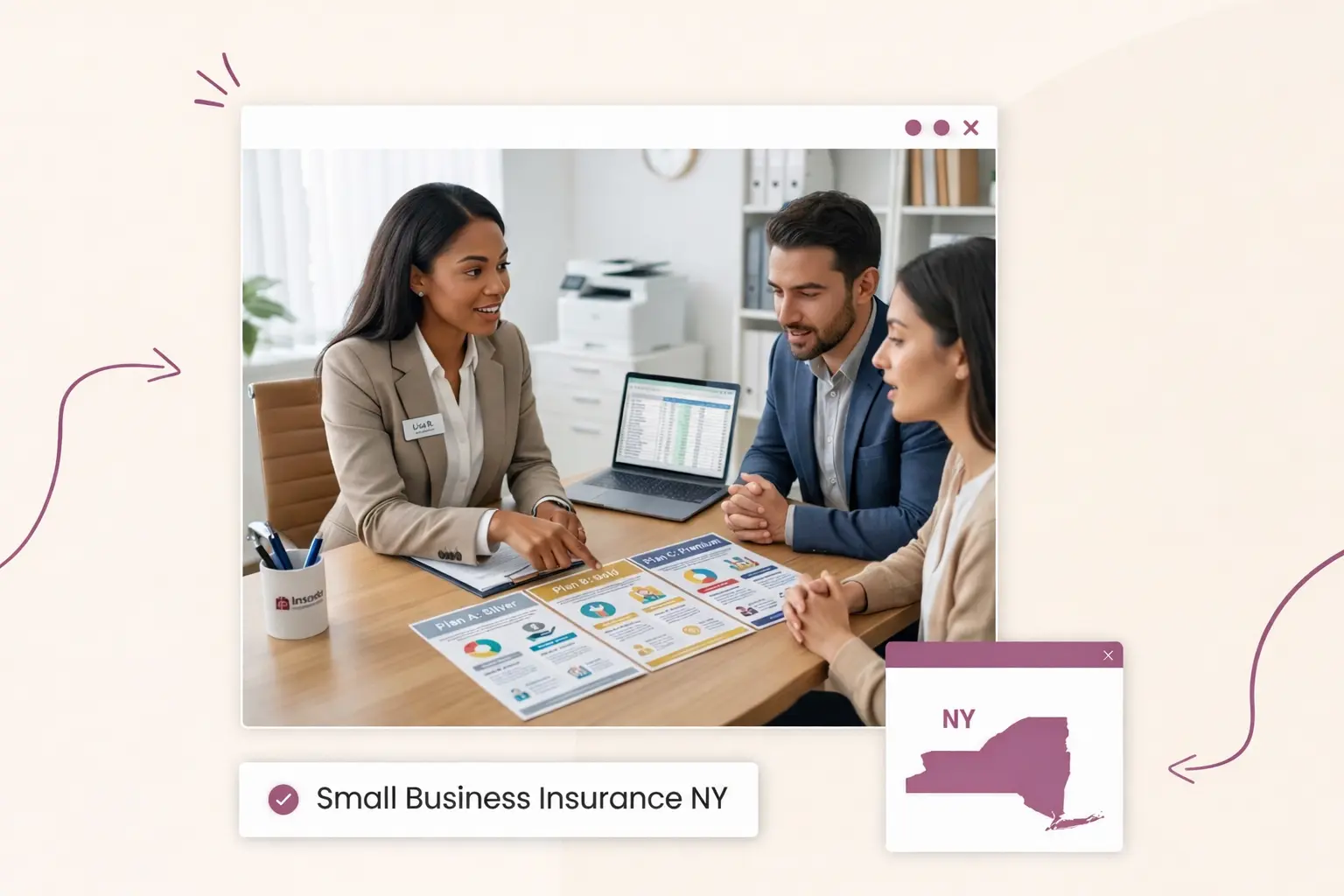
Starting a business in New York involves navigating a number of regulatory requirements, and insurance is one of the most important. Compared to many other states, New York has stricter insurance rules for businesses. Certain policies are legally required, while others are strongly recommended to protect your business.
In this guide, we’ll explain the main types of NY small business insurance, as well as what coverage is legally required, how costs are typically calculated, and how requirements can vary depending on your industry and location.
Is business insurance required in New York?
Not all business insurance is required by law in New York. However, several key policies are mandatory for employers and businesses operating vehicles, including:
- Workers’ compensation: If your business hires employees, workers’ compensation insurance is typically required. This type of insurance covers medical treatment for work-related injuries as well as lost wages during recovery.
- Disability insurance: New York is one of the few states that requires disability insurance for most employers. This coverage provides short-term wage replacement if employees experience an illness or injury that occurs outside of work.
- Commercial auto insurance: If your business owns vehicles used for work purposes, commercial auto insurance is required. This insurance covers liability for accidents, including both property damage and medical expenses related to crashes.
- Industry-specific requirements: Some industries in New York must carry additional insurance depending on licensing or regulatory requirements.
- General liability insurance: While small business liability insurance NY laws do not universally require general liability coverage, it is frequently required by contracts. Clients or project partners may require proof of liability coverage before signing agreements.
Types of small business insurance in NY
It’s important to understand how to choose business insurance. The insurance you need can vary wildly depending on the type of business you operate, but understanding the different types of business insurance that exist in New York is an important place to start:
General liability insurance
General liability insurance is one of the most common policies for small businesses. It protects against claims involving both bodily injury and property damage.
For example, if a customer slips and falls inside your store, general liability coverage may help pay legal expenses or settlements.
Many landlords require tenants to carry general liability insurance as part of a commercial lease. Other industries where this type of coverage is common include retail businesses, restaurants, contractors, and service providers.
Professional liability insurance
Professional liability insurance (sometimes called errors and omissions insurance) protects businesses that provide professional services or advice.
It covers claims involving:
- Negligence
- Mistakes in professional work
- Failure to deliver contracted services
Consultants, accountants, bookkeepers, marketing agencies, and IT professionals commonly carry this type of policy.
Business owners policy (BOP)
A business owner’s policy, or BOP, combines general liability insurance and commercial property coverage into a single package. This type of policy is often used by storefront businesses or office-based companies because it provides broad coverage at a lower cost than purchasing separate policies.
For example, a BOP might cover customer injury claims, property damage, and loss of inventory from theft or natural disaster, all under a single policy.
Workers’ compensation insurance (required in New York)
As we mentioned earlier, workers’ compensation is mandatory for most employers in New York. This policy protects both employees and business owners by covering medical treatment and wage replacement if a worker is injured on the job.
Businesses in industries with higher workplace injury risks (such as construction or manufacturing) tend to pay higher premiums for this coverage.
Disability insurance (required in New York)
New business owners are often surprised by New York’s disability insurance requirement, as New York is one of the few states where carrying disability insurance is mandated for all employers.
This coverage provides partial wage replacement if an employee becomes temporarily disabled due to an off-the-job illness or injury. Unlike workers’ compensation, disability insurance covers incidents that occur outside the workplace.
Most employers must provide this coverage shortly after hiring their first employee.
Cybersecurity insurance
As businesses increase their reliance on digital systems and their collection of customer data, cybersecurity insurance is becoming more common. This type of insurance policy helps cover expenses caused by things like:
- Data breaches
- Ransomware attacks
- Identity theft claims
- System recovery costs
Businesses that handle payment data, customer records, or sensitive information often consider cyber insurance an important risk management tool.
While cybersecurity insurance is not legally required for businesses in New York, some clients and contracts may require it.
Small business insurance NY cost
The cost of small business insurance NY policies depends on several factors and can vary quite a lot from business to business. Insurers calculate premiums based on risk exposure, which means businesses in different industries or locations may pay very different amounts.
Key factors that impact cost include:
- Industry risk level
- Business revenue
- Payroll size
- Number of employees
- Claims history
- Business location within New York
Businesses operating in higher-risk industries, such as construction, food service, or transportation, tend to pay higher premiums.
Typical cost ranges
While the cost of small business insurance in NY can vary a lot, here are the typical cost ranges for different types of policies:
- General liability insurance: Typically costs $30-$80 per month. However, higher-risk industries may pay significantly more.
- Business owner’s policy (BOP): Typically costs $500-$1,500 per year. The cost of a BOP policy heavily depends on property value and coverage limits.
- Professional liability insurance: Typically costs $500-$1,500 per year. Most consultants and service-based businesses will fall within this range.
- Workers’ compensation insurance: Workers’ compensation premiums are based on payroll and job risk classifications. For low-risk roles like office workers, it tends to cost $0.10 to $0.30 per $100 of payroll. For higher-risk roles, it can be much more expensive.
Keep in mind that your business’s location can have a big impact on insurance costs. For example, New York City premiums are often higher due to population density and a higher risk of lawsuits. Upstate regions tend to have lower liability costs, but property risks like severe winter weather can still drive up premiums for certain businesses.
How much is insurance for an LLC in NY?
It’s a common misconception that forming an LLC eliminates the need for insurance. In reality, an LLC and insurance serve different purposes.
An LLC helps protect your personal assets from certain business debts or lawsuits. Insurance, meanwhile, helps cover the cost of claims against the business itself.
To understand how the two work together, as opposed to eliminating the need for the other, let’s look at an example of a customer who injures themselves while using a product and decides to sue the business that manufactured it. Having an LLC would mean that the business owner’s personal assets cannot be targeted in the lawsuit, while general liability insurance would potentially help cover some or all of the damages if the business is found liable.
As for how much insurance costs an LLC New York, the price depends on numerous factors, including the industry, the company’s revenue, its operational risk, and how many people it employs. Even a single-member LLC with no employees may still need liability insurance, particularly if the business interacts with customers.
The most important takeaway is that while forming an LLC is an important legal step for New York business owners, it does not satisfy New York’s insurance requirements.
Health insurance requirements for small businesses in NY
Health insurance rules differ from liability coverage and operate under a different legal framework. Not all businesses must provide health insurance, and the requirements depend largely on the size of the business.
Under federal law, employers with 50 or more full-time employees typically must offer health insurance coverage to their employees. Smaller businesses are not required to provide health insurance but may still choose to offer it as a benefit.
To simplify the process of providing health insurance, New York offers the Small Business Health Options Program (SHOP). This marketplace allows small businesses to compare and purchase group health plans. These plans usually require employers to contribute a percentage of employee premiums, with contribution requirements varying depending on the plan. However, they are still designed to enable small businesses to provide health insurance at more affordable rates.
If you operate a business with no employees and would like health insurance for yourself, you may purchase coverage through the individual marketplace instead of a group plan. These policies function separately from small business health insurance NY employer plans.
Small business insurance Rochester NY
Insurance laws apply statewide in New York, but business environments differ from city to city. This can affect risk exposure and pricing.
In Rochester, several industries play a significant role in the local economy, including:
- Healthcare
- Manufacturing
- Education
- Technology services
Businesses in manufacturing or industrial sectors may face higher workers’ compensation premiums due to workplace injury risks.
Commercial property coverage is also important for Rochester businesses, due largely to the risks created by harsh winter weather. Local insurance brokers in the Rochester area often specialize in coverage for regional industries, which can help business owners find a policy that is tailored to local risks.
Small business insurance Buffalo NY
Buffalo has its own unique economic environment that can influence insurance needs. Key industries in Buffalo include:
- Construction trades
- Logistics and transportation
- Manufacturing
- Healthcare services
Because construction and trade work are common in the region, workers’ compensation coverage is particularly important.
Buffalo businesses may also want to consider property insurance that accounts for snow and ice damage as well as weather-related disruptions.
When to purchase insurance in New York
Timing is an important part of managing NY small business insurance requirements, and it’s often essential to have the right policies in place before certain milestones occur. This can include milestones like:
- Signing a commercial lease
- Hiring employees
- Entering contracts that require proof of coverage
- Opening your business to the public
For example, landlords often request a certificate of insurance (COI) showing liability coverage before allowing a tenant to move into commercial space.
Similarly, contractors frequently must provide proof of insurance before starting work on projects.
Delays in obtaining insurance can slow down licensing, contract approvals, or operational timelines.
Conclusion
Insurance is an essential part of operating a business in New York. The state has stricter requirements than most, and certain policies, particularly workers’ compensation and disability insurance, are legally required.
Remember, LLC status does not eliminate these requirements. While both are important for protecting yourself and your business, they serve different roles.
Many factors influence how much businesses have to pay for different types of insurance polices, with location and industry being two of the big ones. This can sometimes make it tricky to estimate costs until you start shopping for plans and comparing options.
Despite the cost, planning insurance early is highly recommended for New York businesses. By having the right policies in place before you hire employees, sign leases, or enter into contracts, you can prevent compliance issues and ensure that your business is protected as it grows.
FAQ
Workers’ compensation, disability insurance, and commercial auto insurance are legally required, depending on whether you have employees or business vehicles.
No, an LLC protects personal assets from lawsuits, while insurance covers claims against the business itself, so both serve different purposes.
It combines general liability insurance and commercial property coverage into a single package, often used by storefront or office-based businesses.
It typically costs $30 to $80 per month, though higher-risk industries may pay significantly more.
No, federal law generally only requires employers with 50 or more full-time employees to offer health insurance, though smaller businesses can choose to offer it voluntarily.