
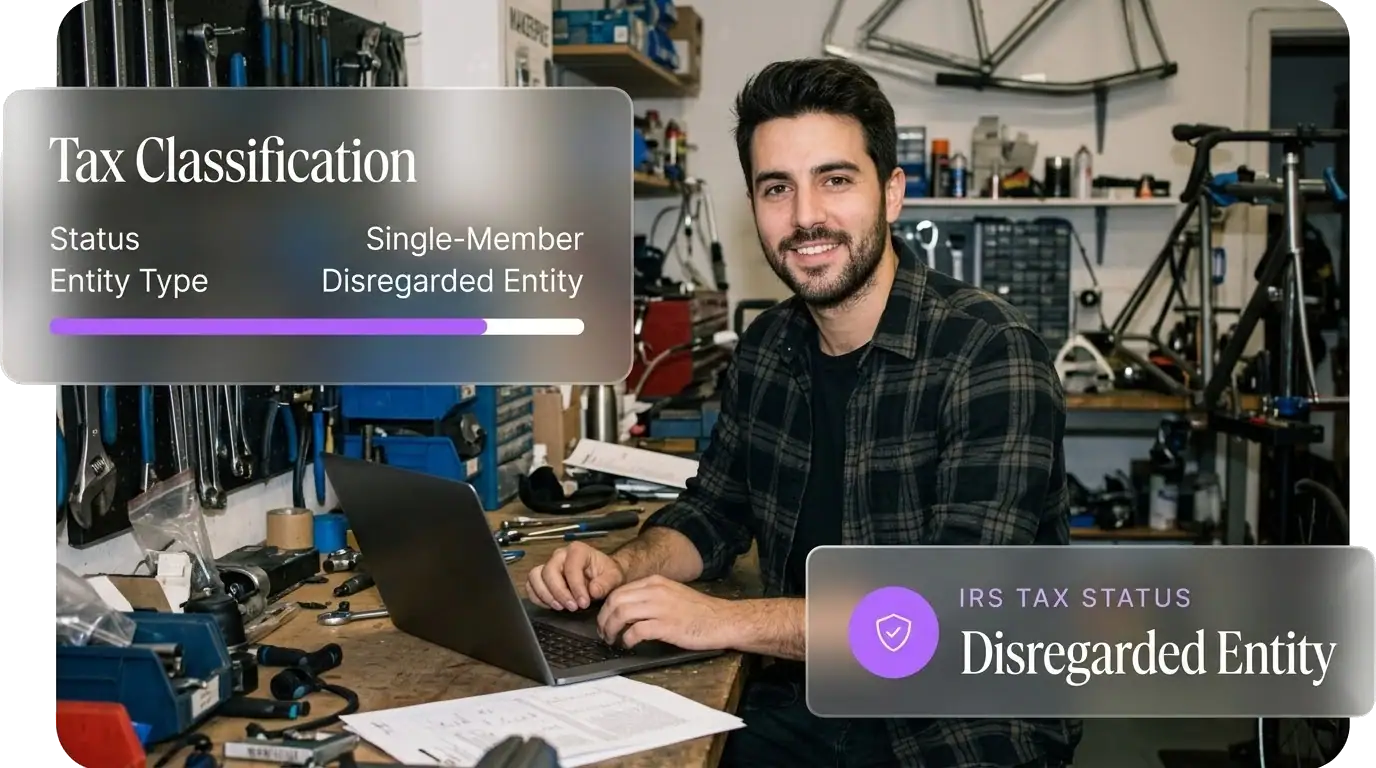
A disregarded entity is a business the IRS ignores for income tax purposes. A single-member LLC‘s profits aren’t taxed at the entity level but flow through to the owner’s return. The owner pays income tax plus self-employment tax. The LLC still counts as separate for payroll and certain excise taxes, and it can elect corporate or S corporation treatment.
What is a disregarded entity?
Federal “check-the-box” rules let an eligible business choose how it is taxed. A domestic entity with one owner that makes no election is “disregarded as an entity separate from its owner” Treas. Reg. Section 301.7701-3 (verified November 2026). According to the IRS, the LLC’s activities are reported on the owner’s federal return (verified November 2026). The owner of the income doesn’t have to be a person:
- A corporation can own an LLC and have income go to the corporation’s Form 1120
- A partnership can have the income go on Form 1065 (IRS single-member LLC page, verified November 2026).
“Disregarded” is a tax label only, so it isn’t a choice of disregarded entity vs LLC: your LLC is both. Your state LLC statute still determines your liability protection, so you must keep business and personal money separate.
There are two important exceptions. For employment and certain excise taxes, the LLC is treated as a separate entity and must use its own name and EIN (IRS single-member LLC page, verified November 2026). You, as the owner, are not an employee of your disregarded LLC, so you pay self-employment tax on the profit, the same as a sole proprietor (IRS single-member LLC page, verified November 2026).

Who this doesn’t apply to
- Multi-member LLCs are taxed as partnerships by default and cannot be disregarded (IRS single-member LLC page, verified November 2026).
- Spouses in community property states who own an LLC together may choose to treat it as disregarded or as a partnership, and the IRS will accept either position (Rev. Proc. 2002-69, verified November 2026). Spouses in other states who co-own an LLC have a partnership.
- Foreign owners. A U.S. LLC wholly owned by a foreign person must file Form 5472 attached to a pro forma Form 1120 (Form 5472 instructions (verified November 2026)). Foreign owners give payers Form W-8, not Form W-9 (Form W-9, verified November 2026).
- LLCs that elect C corporation or S corporation status are not disregarded for income tax.
- State taxes. States don’t always follow federal treatment, so check your state’s rules.
How a single member LLC disregarded entity is taxed
Under disregarded entity tax treatment, the LLC’s net profit is taxed at your individual rates whether or not you take the money out of the LLC. You also owe self-employment (SE) tax on 92.35% of net earnings, calculated on Schedule SE, and you can deduct half of that SE tax when determining your adjusted gross income IRS Topic 554 (verified October 2026). Since you do not have an employer withholding tax, you generally should make quarterly estimated tax payments (IRS self-employment tax page, verified November 2026).
You may also be eligible for the qualified business income deduction of up to 20% of QBI (verified November 2026). Limits based on taxable income and the type of business still apply, and for tax years beginning after 2025 a minimum deduction for active QBI may also apply.
Annual state fees still apply to your LLC even though the IRS disregards it. For example:
- California charges an $800 annual tax Franchise Tax Board (verified October 2026); other states, such as Texas, have their own franchise or annual taxes
- Delaware has a $400 annual tax, due June 1 Division of Corporations (verified November 2026)
- Massachusetts has a $500 annual report filing fee Secretary of the Commonwealth (verified November 2026)

Worked example: $80,000 profit, disregarded vs. S corporation
An illustrative example showing the difference in tax consequences of a disregarded entity and an S corporation may be instructive. It is simplified, covers federal taxes only, and isn’t a prediction of your own tax. For this example, we assume a single-owner LLC with $80,000 of net profit before any owner pay. Under the S corporation election, the owner takes a $45,000 salary.
- Amount subject to payroll/self-employment tax: $73,880 (80,000 × 92.35%) for the disregarded LLC versus $45,000 for the S corporation
- Social Security + Medicare Tax: $11,303.64 (73,880 × 15.3%) for disregarded and $6,885.00 (3,442.50 employee + 3,442.50 employer) for the S corporation
- Profit passed through to owner: $80,000 on Schedule C for the disregarded LLC versus $31,557.50 on K-1 (80,000 – 45,000 – 3,442.50) for the S corporation
- Payroll tax difference: $4,418.64 less for S corporation
| Illustrative: $80,000 profit | Disregarded entity (default) | S corporation election ($45,000 salary) | Source |
|---|---|---|---|
| How you get this status | Default for a one-member LLC; no election | File Form 2553; the S corporation files Form 1120-S | IRS: Single-member LLCs; Form 2553 instructions |
| Amount subject to SE or payroll tax | $73,880 (92.35% of net earnings) | $45,000 salary | IRS Topic 554 |
| Rate | 15.3% SE tax (12.4% Social Security + 2.9% Medicare) | 7.65% employee + 7.65% employer (6.2% + 1.45% each) | IRS Topic 751 |
| SE or payroll tax | $11,303.64 | $6,885.00 | Calculated from the two rows above |
| Profit passed through to owner | $80,000 on Schedule C | $31,557.50 on Schedule K-1 | Calculated: $80,000 − $45,000 − $3,442.50 |
| QBI deduction base | Net profit less half of SE tax | Salary isn’t QBI (employee services are ineligible) | IRS: QBI deduction |
The $4,418.64 payroll-tax difference isn’t all savings. Three things reduce it:
- A smaller QBI deduction. Reasonable compensation paid to an S corporation shareholder is excluded from Qualified Business Income (QBI) (IRS QBI deduction page: income from services as an employee isn’t eligible, verified November 2026). In this illustrative example, QBI falls from $74,348 (profit minus the half-SE-tax deduction) to $31,557.50. That can shrink the deduction by up to $8,560, which costs $1,030 to $1,880 at a 12%–22% bracket. The loss is smaller if the taxable-income cap already limits your deduction. These figures ignore the post-2025 minimum deduction for active QBI.
- A smaller above-the-line deduction. The half-SE-tax deduction ($5,651.82) is larger than the employer FICA the S corporation deducts ($3,442.50). That leaves about $2,209 more income subject to income tax, or roughly $265–$486.
- Compliance costs. You’ll need payroll processing, unemployment tax filings, and a separate Form 1120-S return. In California, the S corporation also owes 1.5% of its net income, with an $800 minimum (California Franchise Tax Board, verified November 2026).
Net result (illustrative): In this example, roughly $2,000 to $3,100 of federal savings before compliance costs, and those costs can absorb much of the savings. At $80,000 of profit, the election is a close call, but it tends to pay off more clearly as profit rises above a defensible salary.
The salary has to hold up. The IRS requires reasonable compensation before distributions and can reclassify distributions as wages. The factors it weighs include your duties, the time you put in, and how much comparable businesses pay (IRS: S corporation compensation, verified November 2026).
Key facts related to Disregarded Entities
- Default status: A one-member LLC is disregarded for income tax unless it elects to be taxed as a corporation (IRS single-member LLC page, verified November 2026).
- Where the income goes: The owner’s return. An individual owner reports it on Schedule C (Form 1040), which is why owners often call it a Schedule C LLC.
- Self-employment tax: 15.3% (12.4% Social Security + 2.9% Medicare) on 92.35% of net earnings; owed if net SE earnings are $400 or more (IRS self-employment tax page, verified November 2026).
- 2026 Social Security cap: $184,500 of combined wages and SE earnings. IRS Topic 751 (verified November 2026)
- Own EIN required?: Generally yes if the LLC has employees or certain excise tax obligations; the IRS notes most new single-member LLCs get one, for example for a bank account or state rules (IRS single-member LLC page, verified November 2026).
- S corp election: File Form 2553 within 2 months and 15 days after the start of the tax year in which it should take effect; no Form 8832 needed. Form 2553 instructions (verified October 2026)
Common mistakes
- Hiring someone and running payroll under your SSN. Wages must be reported under the LLC’s name and EIN.
- Paying yourself a W-2 salary from a disregarded LLC. You aren’t an employee of the LLC. You take draws and pay SE tax.
- Electing S corp status and then paying yourself little or no salary.
- Missing the Form 2553 deadline and assuming the election took effect.
- Forgetting state charges such as California’s $800 annual tax.
- Foreign owners skip Form 5472, which carries a $25,000 penalty for each failure to file (Form 5472 instructions, verified November 2026).
This article is general information, not tax or legal advice. Confirm your situation with a CPA or tax attorney.
FAQs
Is a single-member LLC a disregarded entity?
Yes, by default, for federal income tax. It stops being disregarded if it files
- Form 8832 to be taxed as a corporation
- Form 2553 to be an S corporation (IRS single-member LLC page, verified November 2026).
Even as a disregarded entity, it is a separate entity for payroll and certain excise taxes.
How do I fill out a W-9 as a disregarded entity?
For a disregarded entity W-9, use the current final Form W-9 (Rev. March 2024) (verified November 2026):
- Line 1: Your name as owner, exactly as it appears on your Form 1040. Do not put the LLC’s name here.
- Line 2: Enter the LLC’s name.
- Line 3a: Check the box for your own tax classification, which for an individual is “Individual/sole proprietor.”
- Line 3b: Leave it blank. It applies only if you checked “Partnership” or “Trust/estate,” or checked “LLC” and entered “P” as its tax classification.
- Part I: Enter your SSN or your personal EIN, if you have one.
- Part II: Sign as the person named on Line 1.
Does a disregarded entity need its own EIN?
A disregarded entity generally needs its own EIN if it has employees or owes certain excise taxes. If neither applies, it uses the owner’s name and TIN for federal tax purposes, even though it may get an EIN for a bank account or because state law requires one (IRS single-member LLC page, verified November 2026).
On Form SS-4, check “Other” on line 9a and write “disregarded entity” (SS-4 instructions, verified November 2026). Even with an EIN, your W-9 still shows your own TIN.
Can a disregarded entity elect S corp status?
Yes, by filing Form 2553. A timely Form 2553 counts as the election to be taxed as a corporation, so you don’t also file Form 8832 (Form 2553 instructions, verified November 2026). File it no more than 2 months and 15 days after the start of the tax year it should take effect, or at any time during the year before. For a calendar-year election effective January 1, 2027, the deadline is March 15, 2027.
If you meet the condition, you may qualify for late-election relief within 3 years and 75 days of the effective date. If the election is later terminated or revoked, you generally need IRS consent to re-elect within five years (Form 2553 instructions, verified November 2026). If you request an EIN for this purpose, check “Corporation” on SS-4 line 9a.
Sources
- IRS: Single member limited liability companies (verified November 2026)
- IRS: Form W-9 (Rev. March 2024) (verified November 2026)
- IRS: Topic 554, Self-employment tax (verified November 2026)
- IRS: Self-employment tax (Social Security and Medicare taxes) (verified November 2026)
- IRS: Qualified business income deduction (verified November 2026)
- IRS: Instructions for Form 2553 (verified November 2026)
- IRS: Instructions for Form 5472 (verified November 2026)
- California FTB: Limited liability company (verified November 2026)
- Delaware Division of Corporations: LLC/LP/GP tax instructions (verified November 2026)
- Massachusetts Secretary of the Commonwealth: LLC information (verified November 2026)
- 26 CFR Section 301.7701-3, Classification of certain business entities (verified November 2026)
- IRS: Instructions for Form SS-4 (verified November 2026)
- IRS: Topic 751, Social Security and Medicare withholding rates (verified November 2026)
- IRS: S corporation compensation and medical insurance issues (verified November 2026)
- California FTB: S corporations (verified November 2026)
- IRS: Revenue Procedure 2002-69 (verified November 2026)