

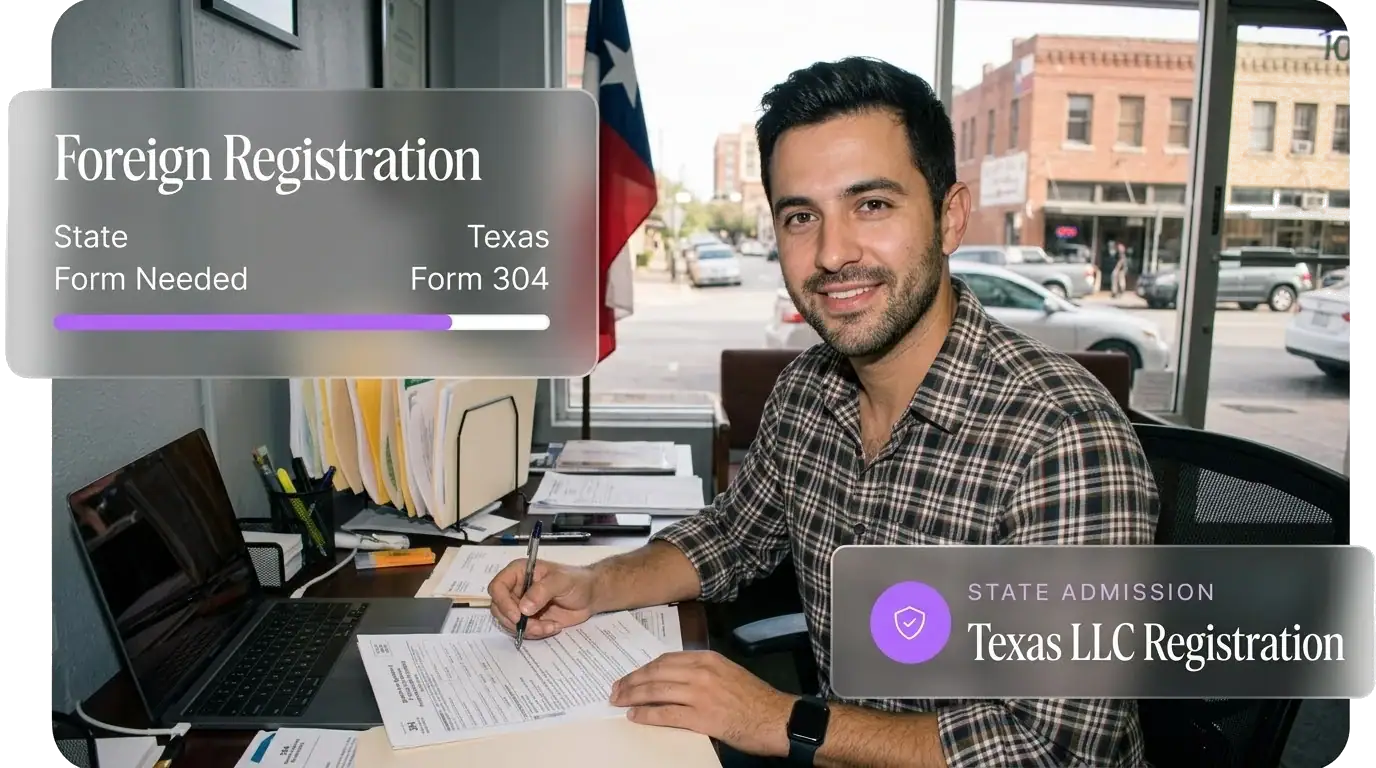
Register a foreign LLC in Texas by completing the Application for Registration of a Foreign Limited Liability Company – Form 304 with the Texas Secretary of State. Texas foreign LLC registration allows a business formed in another state to legally operate in Texas. The process requires an application, filing fee, and use of a registered agent.
Key Facts:
- A foreign LLC in Texas must file Form 304, Application for Registration of a Foreign Limited Liability Company, with the state.
- There is a $750 filing fee (Form 304 instructions).
- Businesses must use a Texas registered agent with a physical street address in the state as part of the process.
- This process is also known as foreign qualification, the steps needed to obtain a Certificate of Authority for a foreign entity (any business not formed within Texas borders).
- Applications may be filed online, by mail, or in person.
Texas foreign LLC registration is generally required for companies that transact business within the state. This isn’t a relocation of the business. It does not replace an LLC currently operating in another state. Instead, registering a foreign LLC in Texas gives you approval from the state of Texas to conduct business there.
What Is a Foreign LLC?
A foreign limited liability company (LLC) is a registered business entity formed in one state but conducting business in a different state. A domestic LLC is an LLC formed and operating within the same state, by contrast.
Most states, including Texas, require a business to petition to register its LLC if the company was formed in another state. This is not the creation of a new LLC, but permission to legally transact business in the second location.
This process is often called foreign qualification. It indicates the business organization formed under another state’s laws, rather than Texas-specific laws. Obtaining a Certificate of Authority allows the foreign company to continue transacting business in Texas while also operating in its home state, or the state where it was initially formed.
What Counts as Doing Business in Texas, Leading to Texas Foreign LLC Registration Requirements
Texas law generally requires an out-of-state entity to register with the Texas Secretary of State when it transacts business in Texas. The Secretary of State notes that an entity with an office or employee in Texas is generally transacting business there, but the test is fact-specific. Some of the most common reasons a business may need to do so include:
- Opening a permanent office, retail location, warehouse, factory, or fulfillment location in Texas.
- Providing onsite services in a physical location in Texas.
- Executing contracts performed within the state’s borders.
- Hiring W-2 employees who are located in the state.
- Using representatives or managers regularly who are in Texas.
- Owning or leasing real estate for business purposes in the state of Texas.
Exceptions to Doing Business in Texas Rules
Section 9.251 of the Texas Business Organizations Code lists activities that don’t, on their own, count as transacting business. Examples include:
- Maintaining a bank account in Texas
- Securing or collecting debts
- Holding meetings for internal affairs
- Selling through independent contractors
- Defending lawsuits or handling legal proceedings in a Texas court
- Transacting business in interstate commerce
- Isolated transactions not part of a repeated, regular pattern of business
If you are unsure if you need to register a foreign LLC in Texas, consider asking a business attorney.
Steps to Register a Foreign LLC in Texas
Under Chapter 9 of the Texas Business Organizations Code, entities not formed under Texas law generally must register before transacting business in the state. This includes LLCs.
If you believe your business meets the doing business in Texas standard, be proactive. Texas gives foreign entities 90 days after they first transact business in the state to register before late filing fees apply. An initial transaction or isolated incident does not establish a requirement. However, the state has more subjective rules about when it determines regular business activities are underway.
Fill Out the Application
The first step to getting started is to fill out Form 304. This form requires you to name your business, or, if the entity name is not available in Texas, list the assumed name. You will need to provide answers to additional questions, including who your registered agent is, the registered agent’s address, and the names of all governing parties within your company. An authorized person must sign and date the form.
Under Sections 5.054 to 5.059 of the Business Organizations Code, a foreign entity must be registered under a name that meets specific requirements, including containing a recognized term of organization for the entity type. The name must be distinguishable from other names on file.
Obtain a Registered Agent
It is possible to operate as your own registered agent, but only if you are a Texas resident with a Texas street address. If you do not, establish a Texas registered agent through a service or another named authorized party.
Pay the Registration Fee and Submit Your Application
The registration fee for a foreign LLC in Texas is $750. Follow all rules established in the Form 304 instructions.
You can submit the application online through SOSPortal. Businesses must create an account through the portal to access the Secretary of State on an ongoing basis. Payments may be made through ACH or credit card (with applicable fees). The evidence of filing is then emailed to the business’s authorized party.
It is also possible to mail in registration applications or complete them in person.
- Mail to: P.O. Box 13697, Austin, TX 78711-3697
- In-person at: 400 West 15th Street, Austin, TX 78701
In both situations, the Secretary of State will process the application and then mail the document to the submitter once the organization is registered.
What Happens If I Don’t Register as a Foreign LLC in Texas?
Operating an out-of-state LLC in Texas without registering as a foreign entity creates several potential risks:
- Late filing fees may apply. If the LLC transacted business in Texas for more than 90 days before registering, the late filing fee is $750 for each calendar year or part of a year of delinquency.
- The LLC may owe a civil penalty equal to the fees and taxes it would have paid had it registered when first required.
- The Texas Attorney General can ask a court to stop the LLC from transacting business in Texas.
- The business may not maintain a lawsuit in a Texas court until it registers. Businesses can still be sued in Texas courts.
| Item | Texas rule | Source |
|---|---|---|
| Form and registered agent | Form 304, Application for Registration of a Foreign Limited Liability Company; names a registered agent (an organization or a Texas-resident individual) with a Texas street address | SOS Form 304 |
| Filing fee and good standing | $750; no separate certificate of good standing (the application states the LLC validly exists under its home-state law) | Form 304 instructions |
| Penalty for not registering | $750 late filing fee per calendar year (or part) if business was transacted more than 90 days before registering; can’t maintain a Texas lawsuit until registered; the Attorney General can seek to stop the LLC from transacting business | SOS foreign entity FAQs |
| Franchise tax | No tax due at or below $2,650,000 annualized total revenue (reports due 2026 and 2027) | Texas Comptroller |
Foreign LLC vs Forming a New LLC: Which Is Cheaper in Texas?
Depending on the situation, you may find forming a new LLC in Texas to be beneficial. Forming a new domestic LLC may be less expensive for several reasons:
- A domestic state filing fee for a new LLC is $300 for the Certificate of Formation (Form 205). The state filing fee for foreign LLCs is $750, which is much higher.
- Franchise tax rules apply to domestic and foreign LLCs doing business in Texas alike, so they usually don’t change the comparison.
- Businesses must continue to meet all compliance requirements in their home state and within Texas. This can add up over time.
Foreign LLC vs domestic LLC decisions can be tough to make.
Example: Expanding an Oklahoma LLC into Texas (illustrative)
Fictional Example Widgets LLC, formed in Oklahoma, opens a Dallas warehouse and hires local staff. Because those are regular in-state activities, it would likely need to register. It appoints a Texas registered agent, files Form 304 online through SOSPortal, and pays the $750 fee. It files within 90 days of first transacting business in Texas, so no late filing fee applies. It doesn’t need a separate certificate of good standing, because the application states that the LLC exists under Oklahoma law. Each year, it checks whether its revenue is above the franchise tax no-tax-due threshold. This is an illustration only; your facts may lead to a different result.
Foreign LLC Texas FAQ
Does my foreign LLC have to pay a Texas franchise tax?
It is always wise to consult with a tax professional for specific insight into your business requirements. However, Texas franchise tax rules are separate. For reports due in 2026 and 2027, an entity with annualized total revenue at or below $2,650,000 owes no franchise tax, though it must still file an information report. This is independent of whether or not the organization must register as an LLC in the state.
Does Texas require a good standing certificate?
Some states require a certificate of good standing issued by the home state indicating the business is up to date on filing and fee requirements under the home state’s rules. Texas’s Form 304 instructions don’t call for a separate certificate of good standing or certificate of existence. Instead, the application includes a statement that the LLC exists as a valid entity under its home-state law.
How long does it take to receive filings after filing a foreign LLC in Texas application?
Processing times vary by filing method and workload. The Secretary of State describes online filing through SOSPortal as the faster option.
Do digital businesses need to register as a foreign LLC in Texas?
It depends on the facts. The Secretary of State notes that having an employee in Texas generally means a foreign entity is transacting business there, so remote employees based in Texas may trigger registration even without an office. Tax nexus for franchise or sales tax is a separate question. Other online activity, such as serving Texas customers remotely, is fact-specific.
Sources
- Texas Secretary of State: Form 304, Application for Registration of a Foreign LLC (verified November 2026)
- Texas Secretary of State: Form 304 instructions (verified November 2026)
- Texas Secretary of State: Foreign or out-of-state entities FAQs (verified November 2026)
- Texas Secretary of State: Form 205, Certificate of Formation (LLC) (verified November 2026)
- Texas Business Organizations Code, Chapter 9: Foreign entities (verified November 2026)
- Texas Comptroller: Franchise tax (verified November 2026)