
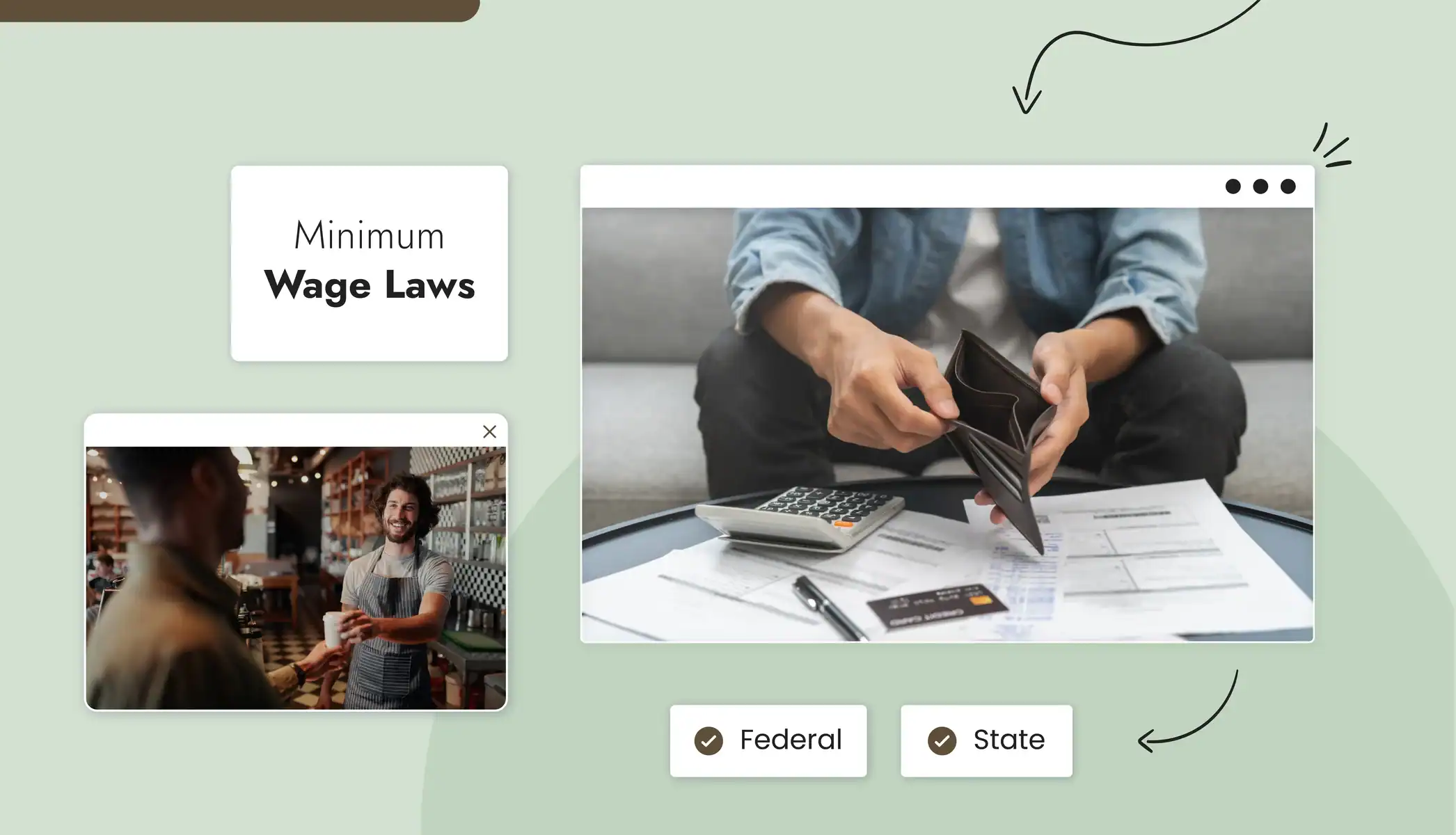
Minimum wage is a centerpiece of modern employee protection. This determines how employers pay workers. Specifically, this highlights the lowest hourly rate that employers are permitted to provide. This designated wage acts as a pay floor, a barrier meant to improve economic security.
From the business owner’s perspective, however, minimum wage can be confusing, but incredibly important when you start hiring employees. This takes multiple forms, after all, with states often setting minimum wages above federal requirements. As a result, wage requirements can vary considerably depending on where businesses are formed and where they operate.
Add city-specific minimum wages, and frequent changes at both the state and local level, and compliance becomes challenging. Employers must be prepared to monitor these changes and adjust payroll accordingly. This guide offers a helpful starting point, detailing how minimum wage works and what it takes to stay compliant.
What is minimum wage?
Minimum wage represents the lowest hourly rate that employers are legally allowed to pay employees in exchange for their work. This can be established at the federal, state, or local level. Applicable minimum wages can vary according to local laws or mandates.
The federal minimum wage is established by Congress, with the Department of Labor providing oversight and enforcement. Similarly, state legislatures often set state minimum wages, which are enforced by state-based labor departments.
Minimum wage requirements may periodically change according to inflation or based on legislative action. Sometimes, changes occur in response to voter-approved ballot measures.
Minimum wage requirements apply to non-exempt employees. Exemptions may be possible in select cases, especially when tipped work is involved.
What is the federal minimum wage?
The Fair Labor Standards Act (FLSA) establishes the right for employees to be paid a minimum wage, along with overtime pay when their work exceeds forty hours per week. Across the nation, this federal minimum wage dictates the lowest possible pay that employers can offer to covered employees.
At the federal level, the minimum wage remains stable and cannot be changed unless Congress passes a federal minimum wage law. This must then be signed into law by the president.
Although this rate applies nationwide, states can mandate their own rates. These rates should not be lower than the federal minimum wage; rather, states have the option to establish wages that exceed the federal mandate. These higher state-based requirements may reflect local economic conditions or differences in cost of living.
The federal minimum wage should be framed as a floor and not a ceiling. When states (or, in some situations, cities) set their own minimum wages, employers must stick with the higher rate.
How federal and state minimum wage laws work together
Differences in federal and state minimum wages cause confusion among many employers. Further complicating matters is the reality that state minimum wages tend to change more frequently than wages established at the federal level.
When in doubt, employers should follow a simple rule of thumb: employees must be paid according to whichever law provides the higher wage. This allows employers to follow both federal and state requirements. After all, by paying the higher, state-based rate, employers automatically comply with stricter state standards while also meeting the baseline established via federal law.
State minimum wage laws
Minimum wage can vary considerably between states and may also be established by specific cities or counties. Changes in local wage requirements also differ, with some states phasing in wages approved by voters while others index wages based on inflation. At the state level, different wage requirements may apply to tipped employees.
Enforcement also differs from one state to the next. Many states rely on dedicated labor departments to conduct audits or investigate wage complaints. Consequences for state-level violations vary as well, although, in most cases, businesses can expect to pay back wages in response to In many states, penalties, interest, or other additional fines may be assessed.
Minimum wage by state
| State | Min Wage ($/hr) | Notes | Gov Source |
|---|---|---|---|
| Alabama | 7.25 | No state law; federal applies | U.S. DOL (FLSA) |
| Alaska | 13.00 | Indexed annually | Alaska Dept. of Labor |
| Arizona | 15.15 | Indexed; local higher possible | AZ Industrial Commission |
| Arkansas | 11.00 | Ballot-set rate | AR Dept. of Labor |
| California | 16.90 | Local rates often higher | CA DIR |
| Colorado | 15.16 | Local rates vary | CO Dept. of Labor |
| Connecticut | 16.94 | Indexed annually | CT Dept. of Labor |
| Delaware | 15.00 | Scheduled increases completed | DE Dept. of Labor |
| DC | 17.95 | Highest rate; indexed annually | DC Dept. of Employment Services |
| Florida | 14.00 | Scheduled to reach $15.00 on Sept 30, 2026 | FL Dept. of Economic Opportunity |
| Georgia | 7.25 | State law is $5.15, but federal $7.25 applies to most workers | GA Dept. of Labor |
| Hawaii | 16.00 | Multi-year increases | HI Dept. of Labor |
| Idaho | 7.25 | Matches federal | ID Dept. of Labor |
| Illinois | 15.00 | Reached target rate | IL Dept. of Labor |
| Indiana | 7.25 | Matches federal | IN Dept. of Labor |
| Iowa | 7.25 | Matches federal | IA Workforce Development |
| Kansas | 7.25 | Matches federal | KS Dept. of Labor |
| Kentucky | 7.25 | Matches federal | KY Labor Cabinet |
| Louisiana | 7.25 | No state law; federal applies | LA Workforce Commission |
| Maine | 15.10 | Indexed annually | ME Dept. of Labor |
| Maryland | 15.00 | Statewide baseline | MD Dept. of Labor |
| Massachusetts | 15.00 | Fixed rate (not indexed) | MA Dept. of Labor |
| Michigan | 13.73 | Indexed formula | MI Dept. of Labor |
| Minnesota | 11.41 | Applies to all employers statewide (2026 update) | MN Dept. of Labor |
| Mississippi | 7.25 | No state law; federal applies | MS Dept. of Employment Security |
| Missouri | 15.00 | Indexed annually | MO Dept. of Labor |
| Montana | 10.85 | Lower rate allowed for very small businesses | MT Dept. of Labor |
| Nebraska | 15.00 | Ballot-driven increases completed | NE Dept. of Labor |
| Nevada | 12.00 | Single unified rate | NV Labor Commissioner |
| New Hampshire | 7.25 | Matches federal | NH Dept. of Labor |
| New Jersey | 15.92 | Lower rates for small/seasonal employers | NJ Dept. of Labor |
| New Mexico | 12.00 | Local higher rates exist | NM Dept. of Workforce Solutions |
| New York | 17.00 | $17.00 (NYC/LI/Westchester); $16.00 elsewhere | NY Dept. of Labor |
| North Carolina | 7.25 | Matches federal | NC Dept. of Labor |
| North Dakota | 7.25 | Matches federal | ND Dept. of Labor |
| Ohio | 11.00 | Lower rate allowed for small employers | OH Dept. of Commerce |
| Oklahoma | 7.25 | Matches federal | OK Dept. of Labor |
| Oregon | 16.30 | $16.30 Portland metro; $15.05 standard; $14.05 nonurban | OR Bureau of Labor |
| Pennsylvania | 7.25 | Matches federal | PA Dept. of Labor |
| Rhode Island | 16.00 | Increased recently | RI Dept. of Labor |
| South Carolina | 7.25 | No state law; federal applies | SC Dept. of Labor |
| South Dakota | 11.85 | Indexed annually | SD Dept. of Labor |
| Tennessee | 7.25 | No state law; federal applies | TN Dept. of Labor |
| Texas | 7.25 | Federal applies to most workers | TX Workforce Commission |
| Utah | 7.25 | Matches federal | UT Labor Commission |
| Vermont | 14.42 | Indexed annually | VT Dept. of Labor |
| Virginia | 12.77 | Gradual increase law | VA Dept. of Labor |
| Washington | 17.13 | Indexed annually | WA Dept. of Labor |
| West Virginia | 8.75 | Above federal | WV Dept. of Labor |
| Wisconsin | 7.25 | Matches federal | WI Dept. of Workforce Development |
| Wyoming | 7.25 | State law is $5.15, but federal $7.25 applies to most workers | WY Dept. of Workforce Services |
California minimum wage law
California sets its own minimum wage, which can vary slightly based on the number of employees. Variations also exist for businesses based nationwide; fast food chains, for example, may need to pay employees a rate that exceeds the state’s standard minimum wage.
The California minimum wage changes frequently in the Golden State, often as new legislation is passed but also in response to inflation. Additional requirements may be established in specific cities or counties. These higher minimum wage standards are common in larger cities such as Los Angeles and San Francisco.
California is known for its strict enforcement of labor laws, with noncompliance often resulting in significant penalties. These may include both statutory penalties paid to the employee and civil penalties paid to the state.
Entrepreneurs looking at how to start a business in California should regularly review state and local requirements to keep up with frequent minimum wage changes and should also be aware of strict overtime requirements. In hiring and recruitment, many California employers avoid quoting exact figures due to frequent changes in the state and local minimum wage.
Florida minimum wage law
Florida sets its own minimum wage that differs from the federal minimum wage. The state’s minimum wage requirements can change in response to voter-approved amendments.
In 2020, Florida voters opted to increase the minimum wage, sparking a gradual shift towards a $15 per hour requirement. Additional increases are possible in the future if sought and approved by voters. Florida also designates a specific minimum wage for tipped cash employees.
If you’re researching how to start a business in Florida, it’s important to note that municipalities are not permitted to enact their own minimum wage. Still, it remains important for businesses to carefully track changes in the state minimum wage, as penalties can be significant: $1,000 per violation, paid to the state.
Illinois minimum wage law
Illinois often exceeds the minimum wage established at the federal level. This trend accelerated in 2019, when the Lifting Up Illinois Working Families Act set the stage for a phased increase in the state’s minimum wage. Following annual minimum wage increases of $1 per year (spanning six years), the state established a long-term minimum wage of $15 in 2025.
In Illinois, municipalities are allowed to establish minimum wage requirements that exceed the state’s minimum. Chicago, for example, maintains a higher minimum wage, with rate increases occurring annually. These minimum wage increases are typically driven by changes to the Consumer Price Index.
Chicago is the only Illinois city to meaningfully take advantage of the state’s option for higher municipal minimum wages. Cook County has sometimes implemented a higher minimum wage than the Illinois rate, but the majority of municipalities have opted out. Currently, the Cook County minimum wage mirrors the state minimum wage.
As in Florida, different minimum wage requirements apply when employees are tipped. In Illinois, employers are permitted to pay 60 percent of the official state minimum wage to workers who receive gratuities.
If you’re starting a business in Illinois and fail to abide by the Illinois Wage Payment and Collection Act, it result in significant damages. Noncompliant employers are expected to cover the full amount of the unpaid wages along with 5 percent of the underpayment for every month in which those wages remain unpaid.
What happens if you violate minimum wage law?
Minimum wage violations can carry negative consequences. Underpayments are not typically intentional. Violations often reflect misunderstandings about overtime rules. In some cases, inconsistent payroll practices are at play.
No matter the reason, minimum wage violations are best avoided because they tend to prompt significant financial penalties. Often, the very businesses that struggle to abide by minimum wage laws are the least equipped to handle penalties due to their limited financial resources.
Consequences imposed at the state and federal level can vary, especially as some states enforce stricter wage laws. With federal requirements, repeated or willful failures to pay the established minimum wage could result in civil penalties of up to $1,000 per violation. Criminal prosecution is also possible, although this is rare.
In cases involving federal minimum wage noncompliance, employers are also expected to pay back wages. These should reflect what employees would have earned if paid correctly from the outset. The FLSA enables the Wage and Hour Division to supervise the payment of back wages, although the Secretary of Labor could potentially bring suits for these wages.
Penalties for state minimum wage violations are often similar, although states may opt to impose higher civil penalties or may apply additional fines.
Minimum wage and payroll compliance
Minimum wage compliance plays into the broader challenge of payroll compliance. Wage errors tend to compound quickly and can be exacerbated by other issues, such as miscalculated overtime or general difficulties in tracking hours worked.
Strengthening business payroll compliance begins with using reliable time-tracking systems. These systems should accurately capture time worked. This means detailing start and end times, along with meal or rest breaks. Changes to scheduled hours should be carefully tracked.
Tech-forward payroll systems limit error-prone manual entries, with transcription errors or even missed time-out punches often causing problems. The best payroll systems also create clear records that can prove useful in the event of an audit.
Setting up your business before hiring employees
Payroll challenges are best avoided through operational readiness. This equips businesses to consistently carry out responsibilities while maintaining full compliance.
A compliance-oriented formation process begins with selecting a legal structure that matches core business goals and values. When starting a small business, many entrepreneurs choose to become a limited liability companies (LLC). Other essential steps include:
- Obtaining an EIN. The Employer Identification Number (EIN) is assigned by the IRS to US businesses. This unique, nine-digit number is meant to identify businesses for tax purposes. These applications can be completed online. Details to submit include the legal name of the entity and the principal business activities.
- Setting up payroll systems. Although payroll can be handled manually, software solutions streamline processes and can often improve compliance. Many employers prefer to outsource payroll, particularly when they lack the dedicated staff or expertise to handle this in-house.
- Register at the state level. State business registration typically involves the local Secretary of State. The process can vary from one location to the next but often involves submitting details about the business and completing business name verifications.
- Clarify federal and state wage obligations. To confirm the highest applicable minimum wage, take a close look at rules that apply at the federal, state, and municipal levels. Compare and contrast these requirements to determine which would be considered the more ‘protective’ from the employee’s perspective. In general, this means paying the highest relevant minimum wage.
Keep in mind that formation supports wage law compliance but does not replace it. Ongoing monitoring is a must, as minimum wage requirements change frequently in many states and may eventually also change at the federal level.
Conclusion
Federal and state minimum wage laws can sometimes seem confusing. Thankfully, proactive formation processes and consistent monitoring can improve wage compliance.
Remember: minimum wage confusion usually relates to differences in how wage requirements are imposed at the state and local level. Clarify these differences early on to avoid complications.
The federal minimum wage provides a consistent baseline, but many states or municipalities require employers to pay higher wages based on local laws or mandates. When in doubt, follow the higher applicable rate but remain mindful of exceptions for tipped employees.
Payroll systems support compliance and reduce risk. Adopt consistent processes and continue to perform check-ins. These proactive strategies make it possible to navigate changing wage requirements with confidence.
FAQ
It’s the lowest hourly rate employers are legally allowed to pay employees, which can be set at the federal, state, or local level.
Employers should always pay whichever rate is higher, since state minimum wages can’t be lower than the federal rate.
Yes, in some states like Illinois, cities such as Chicago can establish higher minimum wages than the statewide rate.
Consequences can include civil penalties, back wage payments, and in rare cases criminal prosecution, with amounts varying by state and federal rules.
Businesses should use reliable time-tracking systems, monitor federal, state, and local wage changes, and pay whichever rate is most protective for employees.