

Running a limited liability company (LLC) means keeping up with a whirlwind of deadlines and reports. Obligations don’t end with business formation filings. Before long, you’ll file annual reports and business license renewals.
With so many administrative obligations, on top of the everyday challenges of running a business, it’s understandable that, on occasion, things might slip through the cracks. Proactive measures can make things easier to manage, but what if you fall behind? Consequences (like administrative dissolution) are discouraging, but there are ways to get your LLC back into good standing.
Don’t let prior mistakes stand in the way of running a successful LLC. Reinstatement is a great option and we’re here to help. In this guide, we’ll show how to reinstate a dissolved LLC. We’ll also help you decide between two viable paths forward: reinstating your LLC or starting fresh with a new business.
What is LLC reinstatement?
LLC reinstatement happens when previously dissolved, revoked (or otherwise inactive) LLCs are restored to active status. If successfully reinstated, LLCs are once again authorized to operate under state laws.
Reinstatement may follow administrative dissolution, in which the state changes the LLC’s status. States may administratively dissolve LLCs if owners do not comply with strict requirements: filing an LLC annual report or paying required fees, for example. Voluntary dissolution, by contrast, happens when the owner chooses to change the LLC’s status.
Dissolution may be described as a loss of good standing. Businesses in good standing are confirmed to comply with all required filings and fees. When LLCs lose good standing, the legal and operational consequences can be significant: these LLCs can no longer legally conduct business and will also struggle to enter into (or enforce) contracts. Bad standing also impedes business banking, making it difficult to open dedicated bank accounts or to secure financing. Meanwhile, business permits and licenses also remain out of reach.
Through reinstatement, LLCs can reclaim good standing and bypass the many restrictions that accompany dissolution. LLCs that successfully navigate this process regain liability protection. Their legal identities are reactivated and their credibility is restored. Think of this as a fresh start, but also, a chance to maintain business continuity.
Why do LLCs get dissolved?
LLC dissolution can take multiple forms. Typically, these are described as either administrative or voluntary. Administrative dissolutions typically involve some sort of lapse in compliance, neglecting to submit an annual report, for example, or not paying required state fees. Issues with registered agents could also play a role. The LLC registered agent is a critical element of becoming a valid LLC, after all, so if a registered agent resigns, and is not replaced, dissolution is possible.
Voluntary dissolution occurs when the LLC owner intentionally chooses to end business operations. This version of dissolution is distinctly proactive on the business owner’s end; the owner initiates the process and must file forms such as articles or statements of dissolution. This decision may be influenced by financial challenges; perhaps the LLC in question is burdened by debt or faces significant difficulties with cash flow. This decision must be made carefully, as voluntarily dissolved LLCs cannot always be reinstated.
Can you reinstate a dissolved LLC?
Dissolution isn’t always permanent. In many cases, it’s possible (and even advisable) to reinstate a dissolved LLC. A lot depends on the location and the timeline: how long the LLC has been dissolved and when the owner hopes to resume operations. States maintain different windows for reinstatement, and, if you wait too long, you may miss your chance. There are also administrative hurdles to clear: filing paperwork, paying fines, and, if relevant, tackling the outstanding obligations that caused the business to be dissolved in the first place.
So, when can you reinstate a dissolved LLC? Reinstatement windows are set state by state, some states allow it for only a year or two after administrative dissolution, others allow five years or longer, and a few impose no deadline at all. California, for example, sets no fixed cutoff, but the underlying tax debt with the Franchise Tax Board has to be resolved no matter how much time has passed. Confirm your specific state’s window with the Secretary of State before assuming you’re still eligible.
How can you reinstate your LLC? Step-by-step
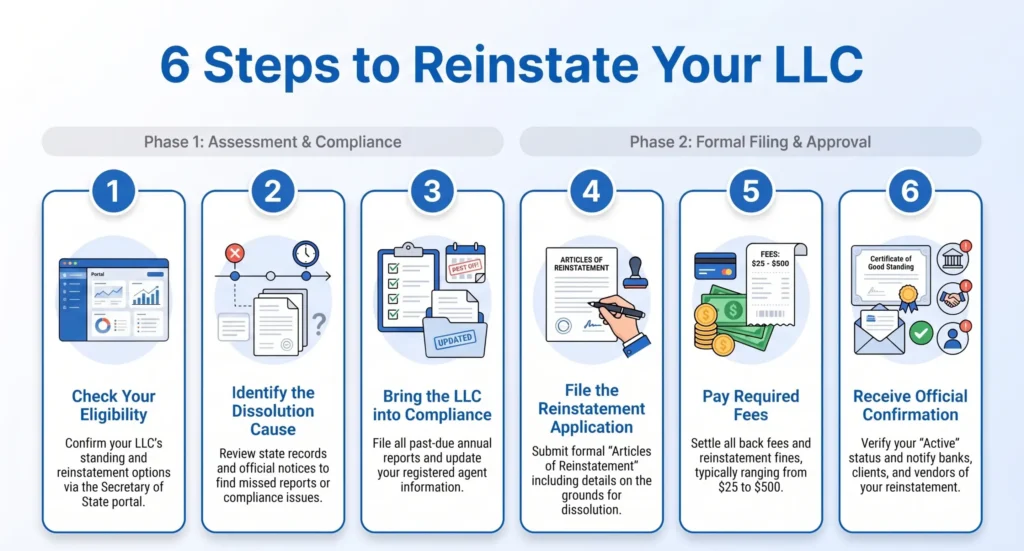
Reinstatement can feel overwhelming at first glance: there are many forms to file and fees to pay. Perhaps you’re wondering: how to reinstate my LLC? This process is best tackled methodically and with support. Follow these steps to reinstate your LLC and regain good standing.
- Step 1: Check your eligibility. First, confirm that you’re actually able to reinstate your LLC. Use the relevant Secretary of State website or portal to confirm your LLC’s current standing and to determine whether reinstatement is a realistic possibility.
- Step 2: Identify what caused the dissolution. Knowing the reason for the dissolution is key to resolving compliance issues. Again, Secretary of State resources can be helpful; you’ll find detailed records of filed or missed annual reports. Review these carefully to determine whether any were previously missed. Next, search for official correspondence, such as emails or notices detailing the administrative dissolution or the concerns that prompted it.
- Step 3: Bring the LLC into compliance. With compliance gaps identified, you should be ready to address outstanding issues. Begin by filing past-due annual reports and paying associated fees. Update registered agent information and other business records before double-checking that all state requirements have been fulfilled.
- Step 4: File the reinstatement application. Many states require formal documentation for reinstating LLCs. These filings may be referred to as articles of reinstatement or applications for reinstatement. Be prepared to share details about the registered agent, along with the effective date of the dissolution or even information about the grounds for dissolution.
- Step 5: Pay reinstatement fees. You can expect to pay several fees or fines before you can reinstate LLC status. These include the back fees for annual reporting (necessary to regain compliance) along with dedicated reinstatement fees, which vary by state and commonly fall somewhere between $25 and $500, check your state’s Secretary of State fee schedule for the exact amount.
- Step 6: Receive your Certificate of Reinstatement. Following approval, states issue certificates or other official confirmation that your LLC has regained good standing and is now in active status. Verify this by visiting the Secretary of State’s database. Consider also reaching out to banks, clients, or vendors to confirm that your business is in good standing.
Keep in mind that processing times can vary. Online filings typically take a few business days, but paper filings could take weeks. Confirm that submissions are correctly filed, as incomplete documents cause further delays. Some jurisdictions offer expedited options, but this comes at an added cost that varies by state and processing speed, check your Secretary of State’s fee schedule for current expedite pricing.
How much does it cost to reinstate an LLC?
Reinstatement fees vary by state, and published fee schedules commonly range from around $25 to $500, confirm the exact amount with your state’s Secretary of State before budgeting for reinstatement. For example, in Florida, reinstating an administratively dissolved LLC costs a $100 reinstatement fee plus $138.75 for each delinquent annual report. In Delaware, a Certificate of Revival costs $200, on top of any back franchise tax (a flat $300 per year) and penalties owed. This is just the beginning, however, and depending on where reinstatement is pursued (or when), other costs could add up quickly.
A major cost involves previously missed annual reporting fees. Like reinstatement fees, annual reporting costs vary significantly by state, some charge roughly $50 a year, while others charge several hundred dollars, so check your specific state’s current fee before estimating total reinstatement cost to maintain good standing. For this reason, longer periods of dissolution tend to prompt higher overall reinstatement expenses.
In some states, reinstatement costs see further increases due to filings beyond the application for reinstatement. For example, many states mandate franchise tax clearance to confirm that tax obligations have been satisfied, and this filing may come with its own separate fee.
Costs also depend on your preferred approach to reinstatement. For example, you may opt for a registered agent service to avoid future issues that could lead to dissolution; pricing varies by provider, with many services falling somewhere in the $199–$400 per year range.
Is it better to reinstate an LLC or start a new one?
Now that you know how to reinstate an LLC, it’s important to confirm that this added effort will actually prove worthwhile. Given the many costs and challenges tied to LLC reinstatement, it’s natural to wonder: would it be better to skip the reinstatement process and start fresh? Launching another LLC delivers all the usual challenges of business formation. Ultimately, this decision comes down to business-specific goals and priorities.
Reasons to reinstate
- Preserve the original LLC name. It can take considerable effort to find and establish an LLC name that meets all state requirements and also works well for branding purposes. When an LLC is closed for good, there is no guarantee that the name remains available. In starting fresh, many businesses seek new names and new trademarks.
- Maintain contracts and agreements. Contracts signed under a particular legal identity may no longer prove valid or enforceable if that business is permanently dissolved. Although the contractual realities of reinstatement can vary from one state to the next, this effort typically sparks a retroactive effect: previously signed contracts are once again legally recognized.
- Keep the original EIN. An IRS-issued Employer Identification Number (EIN) is closely tied to LLCs and play a central role in everything from tax filings to payroll management. New entities demand new EINs, prompting a ripple effect that influences banking relationships and tax reporting.
Reasons to start fresh
- Reinstatement windows close. Sometimes, starting fresh is the only option. Such is the case if reinstatement is no longer legally allowed. Timelines differ, and, while some states are lenient and enable reinstatement after several years of missed annual reports, others are quite strict. In some states, LLC reinstatement is only available for a limited window, sometimes as short as a year or two, after losing good standing, so confirm your state’s specific deadline before assuming reinstatement is still on the table.
- Compliance backlogs. Following years of missed filings, the effort to address compliance gaps could feel overwhelming. Should this prove just as time-consuming as completing articles of organization, a brand new LLC may start to feel more compelling.
- Significant business changes. Updated business models or strategies may call for new entities more closely aligned with adjusted business practices. A new business delivers a clean slate, along with an appealing sense of momentum.
- Voluntary dissolution. Reinstatement may not be available following voluntary dissolution, nor is it always practical from a strategic perspective: if the LLC was closed due to operational challenges or changes in business direction, reinstatement risks a return to the very issues that prompted dissolution in the first place.
When compliance backlogs feel manageable, reinstatement is generally the easier option. It’s often more difficult to build a business identity from scratch. When in doubt, remember: reinstatement is about continuity, while relaunching is about pursuing a new vision.
What happens if you don’t reinstate your LLC?
It can be tempting to leave your LLC dissolved rather than seek reinstatement or a new LLC altogether. This path is incredibly risky: a dissolved LLC does not maintain liability protection, after all, and also lacks credibility. Securing capital becomes difficult and business names are no longer guaranteed. Don’t assume this is the more affordable option; in some states, fees continue to accumulate even after LLCs are administratively dissolved.
How to avoid dissolution in the future
LLC dissolution is best avoided by keeping up with required filings. This calls for proactive measures, beginning with calendar reminders that let you know when annual report deadlines are approaching. Consider working with a registered agent service, which reliably receives notices and improves overall continuity. Get in the habit of reviewing filings and LLC standing at least once every year and take prompt action if you suspect noncompliance.
No matter how you choose to proceed, you can count on Tailor Brands for support. Tailor Brands offers compliance support and registered agent services designed to help you keep track of your filing obligations, or support if you decide to establish a new LLC.
Conclusion
LLC dissolution is not usually permanent. If you act quickly (before the reinstatement window closes), you can restore your LLC while maintaining essential contracts and financial resources. A few filings could be all that stands in the way of resumed liability protection and business continuity.
Remember: you’re not alone in this effort. If you face compliance backlogs or a closing reinstatement window, you can work with a professional to find solutions that allow you to run your business with confidence.