

Customer service can be a hard concept to explain. Some believe it is simply a matter of being nice to customers, but a high-performing business requires a set strategy that is both cross-functional and scalable. Most markets are competitive these days, so providing customers with a great experience is paramount. A successful customer experience strategy should be both clear and practical.
This guide will break down the four pillars of a working strategy, build an actionable framework for it, and create a customer experience strategy template to help grow your business.
What is a customer experience strategy?
It is a structured plan for delivering consistent positive interactions that support the customer journey at every single touchpoint. It includes:
- Holistic Design: The design outlines how the business meets and exceeds a customer’s expectations at each step of the journey.
- Data-Driven Processes: It uses both customer feedback and behavioral data to develop business goals.
- Cross-Functional: This is something many small businesses miss. A practical customer experience strategy isn’t just customer service training. It includes product packaging, billing, and digital spaces.
The digital customer experience is critical in today’s technology-driven environment. A customer experience strategy must address online touch points such as:
- Website performance
- Mobile responsiveness
- Checkout flow
- Automated email communications
- Digital support systems
The modern customer will do much of their business online, so digital may be the only way they experience a brand.
What are the four main pillars of customer experience strategy?
There are four foundational pillars to an effective customer experience strategy. Addressing each is what makes the strategy actionable.
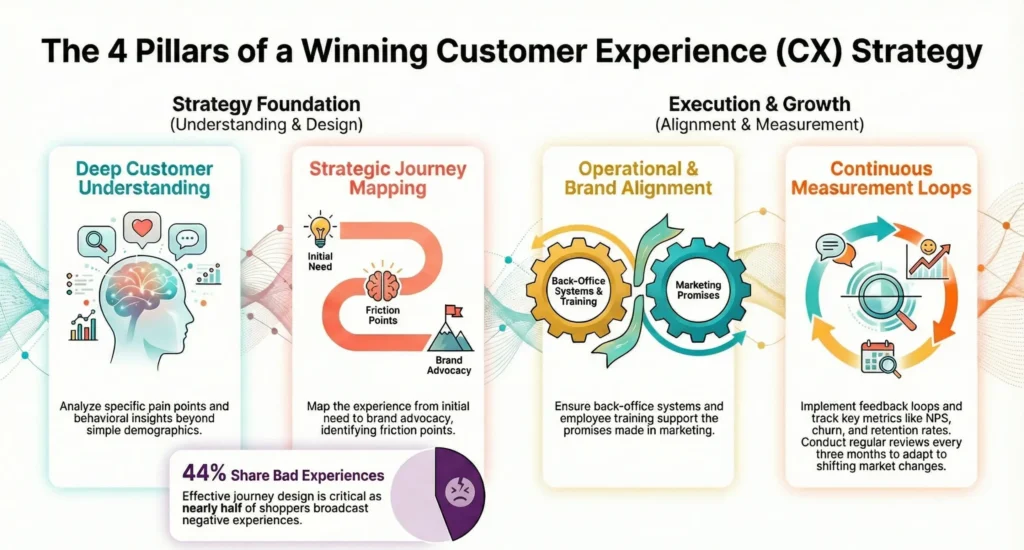
1. Customer understanding
It is impossible to create a successful strategy unless you understand your customer. Creating clear customer personas that go beyond demographics takes that understanding to the next level. They should include:
- Pain points: What is keeping customers from engaging?
- Expectations: How do customers differentiate between good and exceptional service?
- Behavioral insights: How do customers prefer to shop and communicate?
- Feedback analysis: What are customers saying they need in reviews and support tickets?
2. Journey design
Mapping out the customer journey takes you from the minute they realize they need something to becoming a loyal brand customer and advocate. A bad customer experience has the opposite effect. Data shows that 44% of online shoppers will share a bad experience with their friends and colleagues. The map helps to:
- Identify friction points: Where do customers get frustrated or confused?
- Intentional interactions: Where are the specific moments that make them happy?
- Brand alignment: Ensuring each touchpoint delivers the brand message and core values consistently.
3. Operational alignment
Operational alignment is a common oversight in customer experience management. Businesses often fail to align back-office issues with front-office promises. The brand’s reputation is reliant on meeting customer expectations and keeping promises, which requires alignment between all departments.
Marketing talking points and operational activity must align. If an ad pinpoints fast, free delivery, the business should provide exactly that. A survey found that 70% of consumers say they will leave a brand after just two bad experiences. That demands:
- Internal system alignment: The CRM and order management tools must talk the talk.
- Communication workflow: Documentation across departments must enable information to flow.
- Training: Employees must have the resources to make it all work and the authority to resolve customer issues.
4. Measurement and improvement
The strategy must undergo constant evaluation to keep it relevant. Having the right tools in place is critical, such as:
- Key metrics: retention rates, churn, repeat purchases, and Net Promoter Scores (NPS).
- Feedback loops: The strategy should include a communication system that enables customers to suggest changes to meet their needs better.
- Regular audits: Reviewing the strategy each quarter will help the company adapt to market changes.
How to develop a customer experience strategy
Commitment, not budget, is the key to building a strategy that works.
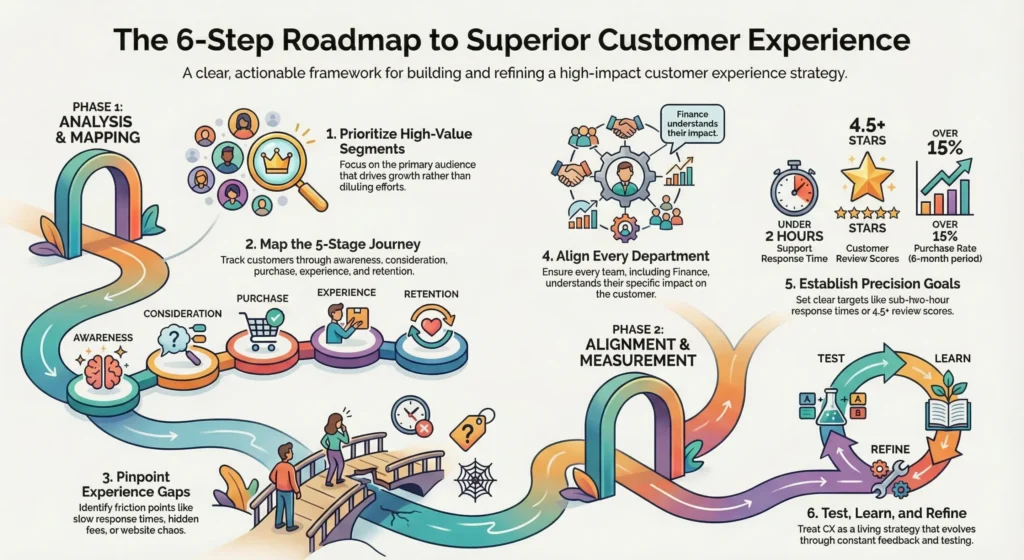
Step 1: Define your customer segments
When starting a small business, it’s important to ask, who is the primary audience? That is the master the brand must serve. It is impossible to try to strategize for everyone equally; that will just dilute the experience. Instead, prioritize the high-value customers to drive long-term business growth.
Step 2: Map your current customer journey
Understand the five stages of the customer journey and how they apply to your business. They include: awareness, consideration, purchase, experience, and retention. That will allow you to ask the right questions, such as:
- Where are the drop-offs in customer service?
- At what point does the communication stop?
- What issues annoy customers along this journey?
Step 3: Identify your biggest experience gaps
Some common gaps include:
- Slow response times for support.
- Confusing pricing or hidden fees.
- Website chaos and friction, such as too many clicks to check out.
- Poor follow-up after a purchase.
Step 4: Align teams around CX priorities
Ensure each area of the business understands its role in the customer journey. What is the finance department’s invoicing approach, and how does it impact customers? What final impression does it leave?
Step 5: Establish measurable goals
Choose measurable goals to help monitor the effectiveness of the customer experience strategy. Avoid vague terminology, such as “What makes the customer happy?” Focus instead on precision goals:
- Reducing the support response time to under two hours.
- Increasing purchase rates to over 15% in a six-month period.
- Improving review scores to at least 4.5.
Step 6: Implement and refine
Customer expectations change, and the strategy must evolve to manage those new needs. Businesses should test small improvements in their systems, get immediate feedback, and then adjust. A customer experience strategy is a living thing that changes when necessary.
Customer experience strategy examples: the e-commerce boutique
Consider how a small, online apparel brand might target young professionals as its priority customers with each pillar.
Customer understanding: focus on efficiency
Pain points: Slow shipping times
Strategy: Flashy packaging is holding up shipping. The target audience values time and sustainability over packaging aesthetics. Changing the packaging can clear a significant bottleneck.
Journey design: reduce post-purchase friction
Pain point: Unclear return policies.
Strategy: Implement a one-click return function with transparent, real-time shipping notifications to make returns easy to process.
Operational alignment: initiate system integration
Pain point: Out-of-stock inventory discovered after payment processing
Strategy: Initiate an integrated inventory tracking system on the website to prevent the processing of out-of-stock items.
Measurement: close the loop using metrics
Pain point: Ensuring the new return system works effectively.
Strategy: Track the return-customer rate using the new one-click system.
Tying an actionable strategy to measurable outcomes means every dollar the brand spends on CX is a worthwhile investment with significant ROI.
What makes a digital customer experience strategy different?
The core principles of the strategy remain the same, but in the digital environment, the focus is on the technical infrastructure.
- Website performance: Customers will not hang around for slow-loading webpages, regardless of how good a product is. Slow websites create bad customer experiences. Google’s landmark study found that 53% of mobile users will leave a website if the page takes more than three seconds to load.
- Automation: Automation creates a customer service presence without 24/7 staffing. Tools such as AI chatbots or automated email programs enhance the customer experience.
- Omnichannel communications: Ensures that customers on different channels have support. For instance, someone who DMs a support agent on Instagram gets total support. That agent should be able to see all previous communications, even if on a different channel, such as emails.
- Data Visibility: Analytics show where customers bounce out of the website.
Common mistakes in customer experience strategies
Many small businesses fail to thrive or grow because they fall into some common customer experience pitfalls.
1. Treating CX as customer service only
In looking at customer experience vs customer service, customer service is a company-wide consideration. It is not something that just affects the person who answers the phone. A flawed product or confusing invoice also impacts the customer experience. The best support agent in the world can’t fix a bad customer experience.
2. Overcomplicating the strategy
Common sense should prevail when building a customer experience strategy. It doesn’t have to be a 50-page document that nobody reads. Focus on solving customer problems, not on having the most expensive technology on board. Start with high-friction points and work your way down to the lesser issues.
3. Failing to align operations
Communication between departments is key to good customer experiences. If the marketing department makes a promise that shipping can’t keep, it’s a problem. This kind of misalignment creates confusion for customers and erodes their trust.
4. Ignoring measurement
If you don’t track it, you can’t know if it works. It is not enough to collect data; it must be analyzed and tied directly to operational concerns and necessary changes.
Supporting your strategy with strong foundations
A customer experience management strategy is only as good as the infrastructure that supports it. It is critical that businesses maintain consistency. To do this, they need:
- Clear branding: Branding is the verbal and visual identity that sets customer expectations.
- Organized systems: Documented processes mean customers get the same level of service at each stage of their journey.
- Reliable communication: Communication is a consistent theme in this guide for a reason. Establishing workflows between internal teams and external clients ensures all pieces work in concert.
Platforms such as Tailor Brands help entrepreneurs build the professional foundation they need to enhance the customer experience. By providing the right tools, they help businesses establish a professional brand identity and organize their infrastructure to deliver the big-brand service customers expect.
Conclusion
A clear and practical plan to improve and evolve the customer experience may be the difference between a business that thrives even in a competitive market and one that dies within the first year.
By focusing on the four pillars—understanding, design, alignment, and measurement—small businesses can develop scalable frameworks that provide growth. It doesn’t take a significant budget or a complicated strategy to meet customer experience goals. The best strategy is one that ensures every interaction along the customer journey works towards building long-term relationships.