
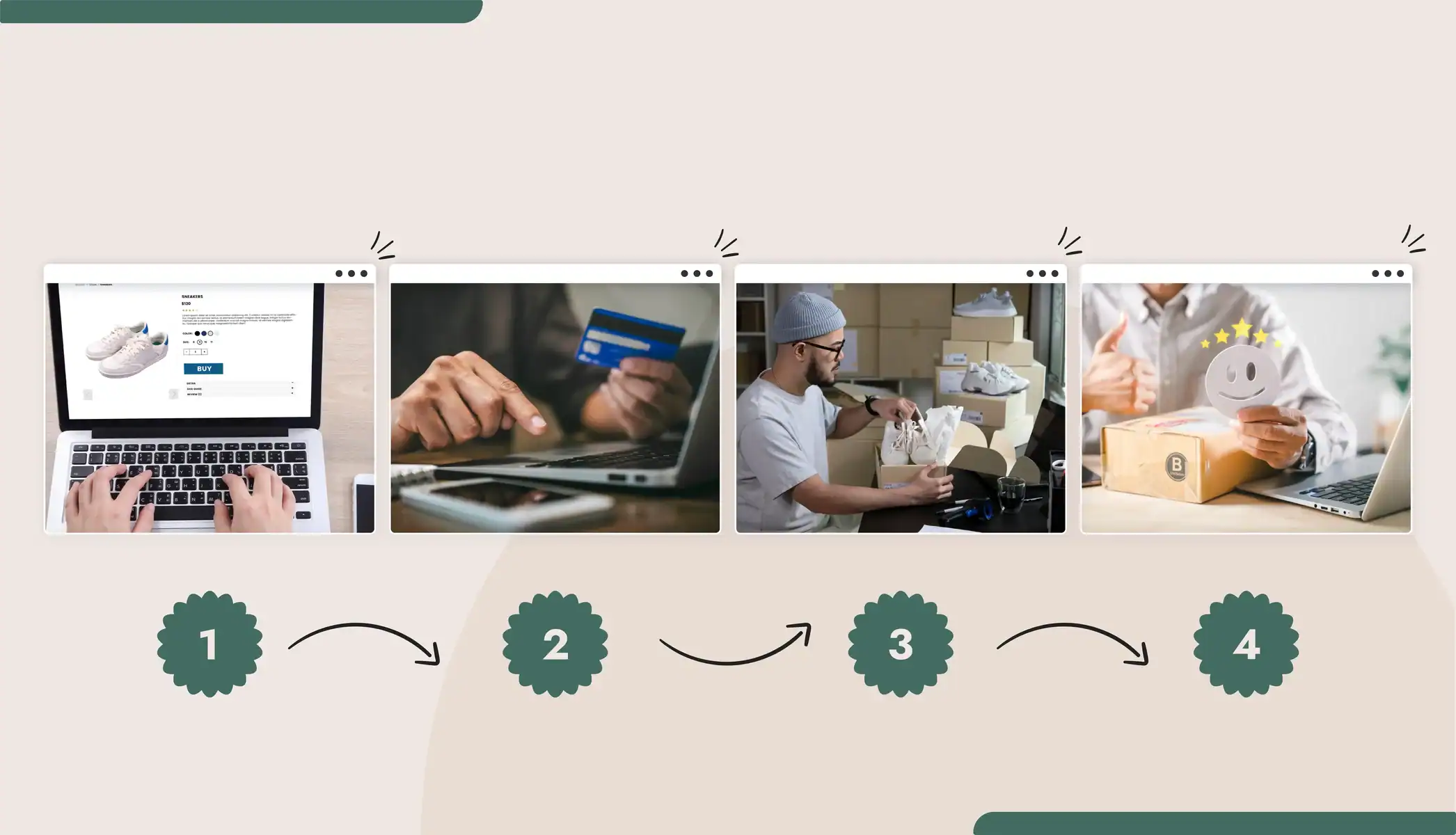
A customer’s journey is the summation of the interactions the customer has experienced with your company, beginning when they first heard about your brand, to the very last post-purchase experience and beyond. Mapping a customer experience (CX) involves identifying each stage through the entire process.
Customer journey mapping is a way for you as a business to visualize this process, walking the same pathway as your customers, and allows you to see key areas where improvement could be made to make the journey easier.
The following information will guide you as you quantify customer experiences, key stages, and integrate various helpful elements to build a strong yet simple customer experience. By the end, you will know how to build a simple experience journey map that will serve the purpose you desire for your brand, ensuring your message is getting through to your customers as intended.
What is a customer journey experience?
A customer experience is a cumulative bookend of experiences beginning when a customer first hears about your brand. It goes all the way through various touchpoints and ends after purchase through loyalty actions on the customer’s part or follow-up by your brand. It is, in essence, the entire relationship between your brand and your customer, from start to end.
It includes marketing, browsing, purchasing, onboarding, service, and then follow-up. It focuses primarily on emotion and perception, not just the actions taken, meaning it can involve how a customer perceives interactions, not just what actions take place. It often happens throughout both digital and offline touchpoints. Keep in mind, a solitary bad interaction can negatively shape the whole customer journey experience. Therefore, it’s important to focus on creating the right kind of customer journey experience, which leads us to the next point:
What is customer experience journey mapping?
A customer experience journey map is a visual and chronological representation of all the stages, interactions or touchpoints a customer has with your brand. It is a visual guide that showcases how a customer moves from initial awareness to retention. Often, seeing this mapped out in plain visual order can reveal friction or pain points, which allows you to focus your efforts more appropriately towards the right kind of improvements.
A customer experience journey map should not be a “wish for” map or a goal. Instead, it is the reality as a real customer has experienced it, mapping their behavior, not made of assumptions or preferences. It is a tool best utilized to improve clarity and consistency and can sometimes be a hard pill to swallow.
Customer journey stages
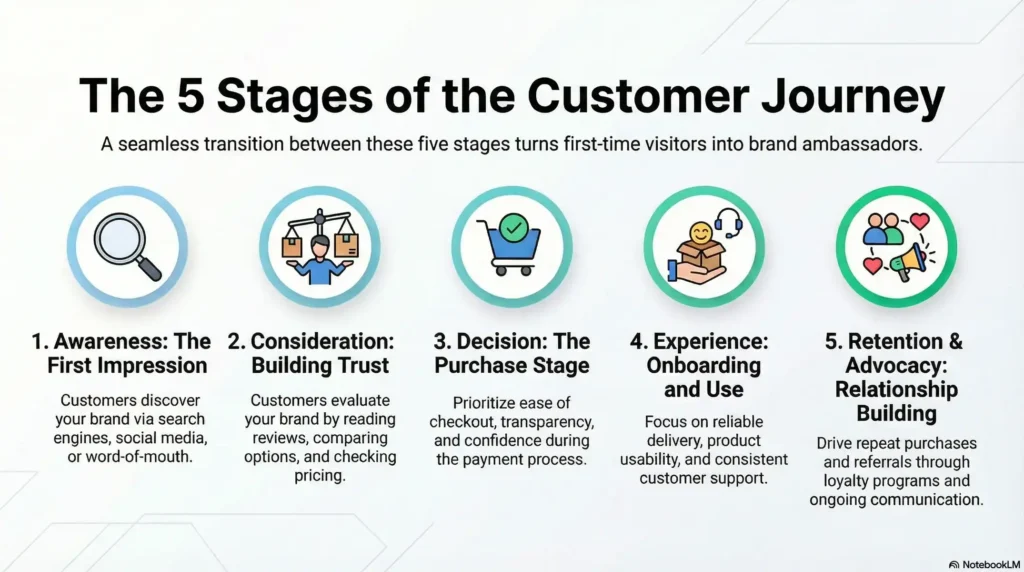
Most customer experience journeys flow through five core stages or steps. This journey, obviously, will vary by industry. However, the following structure will often broadly apply:
1. Awareness
This is the stage of the customer journey where they become aware of your business. This can be through word-of-mouth, using search engines, ads, social media or other forms of marketing. This is the all-important “first impression” you leave with a customer and sets the stage for the rest of their journey. Make sure your message is clear and concise in this stage and is relevant to your brand.
2. Consideration
The next stage of the typical customer journey will include consideration. At this point, customers could visit your website, read reviews, compare options with other brands and even request a quote or more information as they are considering moving forward. This stage allows you to build trust with your customer. Make sure you address any concerns, answer any questions and ensure clear pricing.
3. Decision
This stage could also be titled purchase. It is when the customer moves through the checkout process. They make a payment and confirmation is communicated. The key factors for this stage are ease of completion and also offering a level of transparency and confidence for customers.
4. Experience
Experience could also be called the product or service use stage. It is the onboarding process where a customer is using either the service or product they purchased. It can include support access and product usability and also involves the delivery process. Make sure this stage is reliable and consistent and that you set realistic expectations on all aspects from the delivery to the product or service itself.
5. Retention and advocacy
The fifth and final stage is when a customer follows up. It can include ongoing communication, loyalty programs, repeat purchases, or reviews and referrals. It is a long-term valuable stage and is key to relationship-building.
It’s important to remember when considering these stages that not all customer journeys are linear. Customers can and do move back and forth between stages, so their journey stages can often overlap. That’s okay, it’s just the reality of the process!
Key elements of customer journey maps
Now that we have contemplated the stages of a customer experience journeys and explored the ways customer journey mapping could help identify areas that could be improved, let’s consider the key elements that every customer journey map should include:
Customer persona
The first entry on the map should be the customer persona. This is where you define who the journey represents. Different customer types will require different maps.
Touchpoints
This would include key touchpoints of the customer journey. Touchpoints are concrete, specific moments of interaction between a customer and your brand. This can include your website, emails, social media, phone, in-person interaction and billing communications. Touchpoints should be key elements of a customer journey map.
Customer goals
This part of CX journey mapping would include your customer’s goals. This is what your customer is trying to accomplish at each stage of their journey. It would involve defining their expectations.
Pain points
This part of the process is where it can get a little tough to face reality. This is the part of the map that highlights customer pain points. Common pain points that might reveal themselves through the mapping process include poor communication, unclear pricing, delays, and confusion. For example, 79% of consumers believe that short wait times should be a fundamental part of the support experience, yet only 61% experience short wait times. This pain point has a huge negative effect on customers, and can be easily adapted and fixed once recognized. Remember, while rooting out pain points isn’t pleasant, identifying them gives you the chance to make positive changes.
Emotional response
The last aspect of a customer journey map should include the customer’s emotional response to the entire experience. This can include emotions like excitement, anxiety, frustration, and satisfaction. Mapping emotions can often reveal points of friction more quickly than merely mapping the steps alone, so it’s worth doing for a complete picture.
Customer journey map example
The following is a customer experience journey map template, which is an example of a customer journey map that might exist for an entrepreneur looking at how to start a landscaping business:
Awareness
The customer sees an ad online for a lawn care service. They are interested in knowing more.
Consideration
The customer follows-up by visiting the landscaping company’s website. Then reads online product testimonials and maybe even compares prices and services with other companies in the area.
Decision
They decide they want to go with the landscaping company for a test run mow and weed eating. They set the appointment for a day next week on the company’s site and are sent a follow-up confirmation email.
Experience
The service is performed, and then a follow-up message is sent from the company to the customer about their experience.
Retention
The customer is offered a discount for additional bookings and/or encouraged to leave a review.
When you map this entire customer journey process, it should show you areas that are confusing or possible points of friction. For example, it can showcase slow confirmation or confusing booking forms. You walk through the process of building customer experience journey map examples just as if you would as a customer and see what jumps out of you as you walk those steps, both in terms of the good and bad aspects of the customer journey.
How to create a simple customer experience journey map
Now that you know a general idea of how to create a customer experience journey map, let’s consider some actionable tips and practical steps to follow to create this simple map:
Step 1: Choose one customer type
You will get bogged down if you try to map every type of customer at once. Instead, aim at one customer type, perhaps the persona you are struggling to succeed with to map out first. Then, move on to others.
Step 2: List all touchpoints
Don’t neglect to consider even one possible touchpoint, make sure they are all included in your map:
- Marketing
- Sales
- Service
- Billing
- Follow-up
Step 3: Identify friction and drop-offs
Use this step to identify areas of customer drop off or friction. Where do customers hesitate? Where are complaints occurring? Where is abandonment happening?
Step 4: Prioritize improvements
Fix the high-friction areas first and focus on clarity and speed overall. You can’t make wide sweeping changes instantly, so aim for where it will make the most impact.
It’s worth noting the customer experience journey mapping is not a one-and-done tool. It should be revisited regularly and should be an ongoing part of your overall business evaluation and customer experience process.
Customer experience journey mapping for small businesses
Whether you’re just starting a business or growing operations, creating a customer experience journey map is applicable and easy enough to accomplish. There is no special software required, a simple whiteboard or spreadsheet works. This is where you put team collaboration, customer interviews to work, and don’t forget about those support ticket reviews. Start small, and then refine the process as you get better at the process. Simplicity is the most effective.
Supporting your customer journey with strong operations
Implementing the information you learned through your customer experience journey map will help you better support your customers through strong operations. Make sure that you have organized internal workflows, have clear communication processes, are consistent in your branding and have reliable follow-up systems on board.
At Tailor Brands, we are happy to help you as an entrepreneur build your professional brand by helping you maintain organized business operations, enabling you to support a more consistent customer experience journey across all touchpoints. Intentional mapping drives improvement and the right tools support your ongoing improved structure.
Conclusion
A customer experience journey map will reveal friction and areas that could be improved upon, and even small improvements can compound over time to incentivize real change. Every customer follows a journey and the five stages of this journey provide the ideal structure to build a map upon. The process of mapping should be continuous and always be a tool in your arsenal as a brand dedicated to your customers. Contact us at Tailor Brand for more insights on maintaining a high level of organization and support in your business